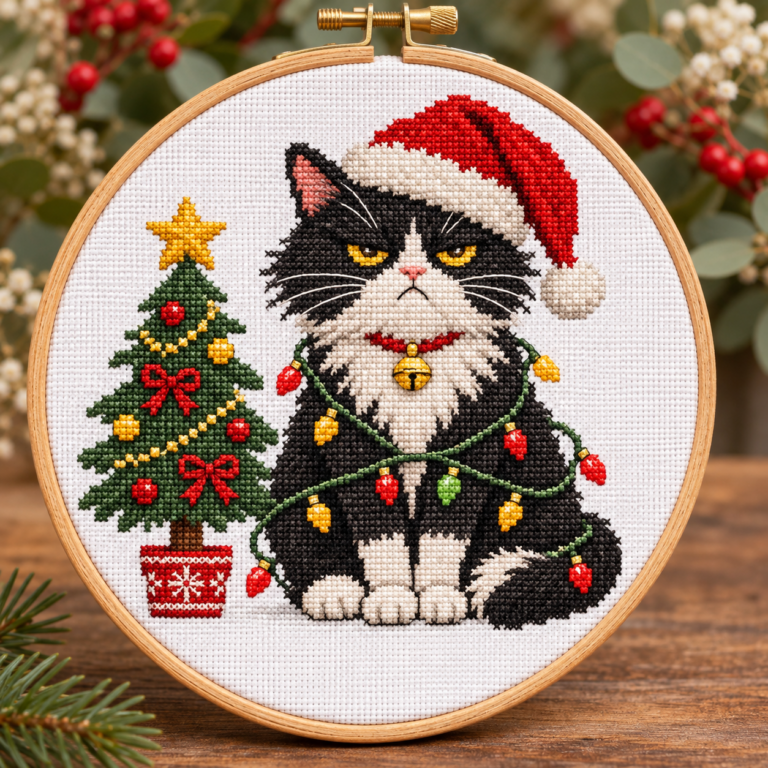

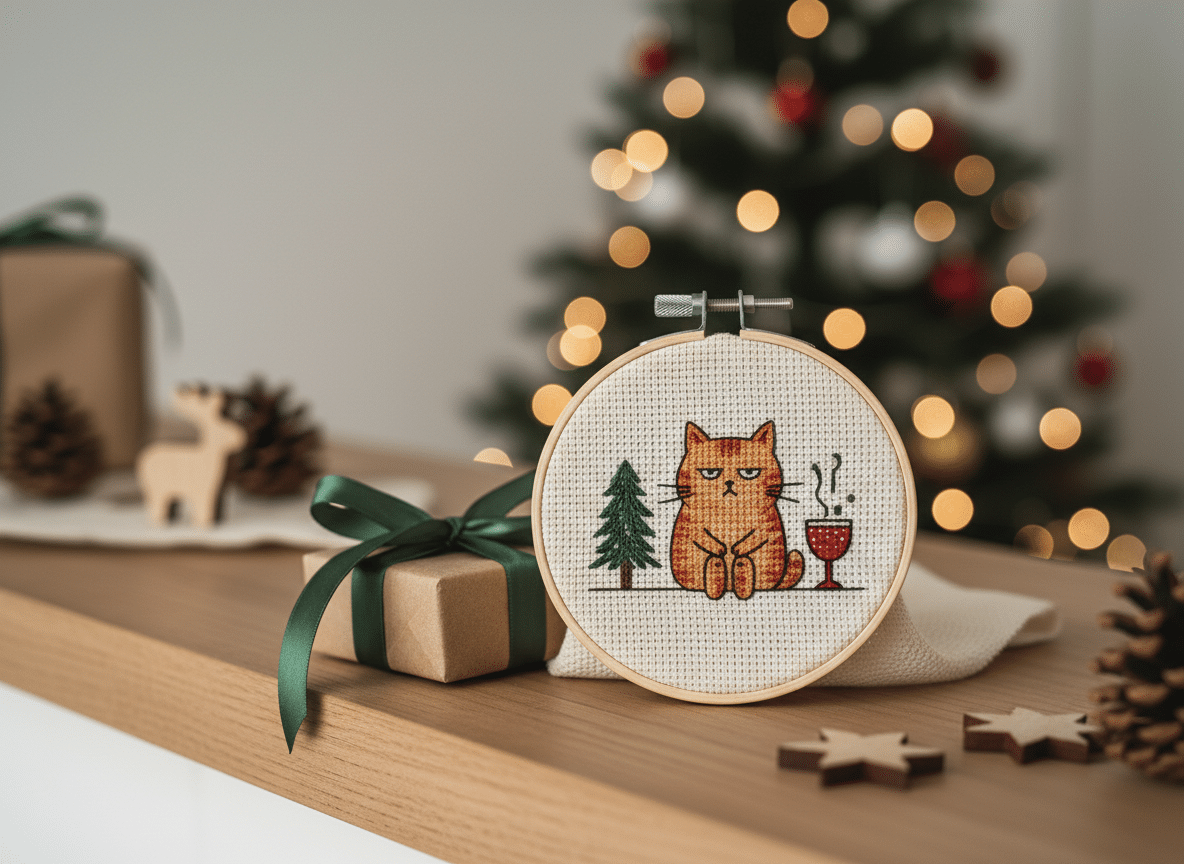
أ Christmas cat cross stitch pattern with wine is the sort of holiday design that gets a second look: a cat with a slightly exhausted expression, a wine glass and a decorated Christmas tree. For a different grumpy holiday-cat design, our funny Christmas cat cross stitch PDF guide examines a Santa-hat kitten with colored lights and a verified 111 × 120-stitch grid. It feels less like a traditional festive greeting and more like the end of a long December day. That makes it a fun choice for adult cat lovers, a craft-night gift or a humorous addition to a seasonal gallery wall.
The particular Christmas cat PDF listed by PixelToStitchCo on Etsy is described by its seller as a 135 × 135-stitch design with 10 colors, provided as two PDF files. Those are seller-reported details, not independently counted from the PDF charts. This guide uses the disclosed measurements for real fabric calculations and offers a practical stitching plan without reproducing the designer’s paid chart, symbols or artwork.
Why the cat, wine glass and Christmas tree make a memorable scene
Three elements carry different jobs in the picture. The cat supplies the expression and personality. The wine glass delivers the joke. The Christmas tree anchors the scene unmistakably in the holiday season. If the motifs are allowed to compete equally for attention, small details can become difficult to read from across a room. A good stitched result keeps the relationship between these three visual anchors recognizable.
For the cat, prioritize its head position, ear shape and the contrast surrounding its eyes and mouth. For the glass, look for the outline of the bowl and where it meets the stem. For the tree, identify a clear triangular outline, a trunk or base and the most important decorations. The aim is not to invent extra stitches, but to recognize which parts of the supplied chart will need special checking as you work.
This is a grown-up holiday-humor theme. A wine glass is a decorative motif in the embroidery, not an instruction to give alcohol to a pet. If you stage your finished needlework with real drinks at a gathering, keep them out of reach of cats and other animals.
Choose an appropriate place to display the humor
A living room reading corner, home craft room, adult Secret Santa gift or festive cocktail-area shelf can be a better fit than a child’s bedroom. The design can look charming next to minimal pine greenery and a small stack of books. If your decorating style is more classic, a plain wood frame gives the joke room to speak for itself without competing with glitter and oversized bows.
What does the Etsy PDF listing actually confirm?
The seller’s publicly accessible description identifies a 135 × 135-stitch design, ten colors and a digital delivery of two PDFs. It also describes a serious, slightly burned-out cat beside a Christmas tree with a glass of wine. We can make useful plans from these details, but the current public text does not establish the exact DMC thread numbers, stitch-type breakdown, how much floss is needed, or whether either PDF is a black-and-white chart. Check the download and its legend before making a supply order.
| Seller-disclosed item | What it means for your project | What still needs checking |
|---|---|---|
| 135 × 135 stitches | Square design boundary used for fabric and framing estimates | Whether the entire square is filled |
| 10 colors | Ten-color palette reported by the seller | Actual floss codes, brand and amounts |
| Two PDF files | Digital chart files rather than a physical kit | Whether charts are color, grayscale or alternate layouts |
| Cat + wine + Christmas tree | Adult humorous holiday composition | Exact symbol placement and any backstitch |
A chart square is not the same as one completed cross. The outer 135 × 135 grid contains 18,225 possible positions, but unstitched background areas may mean far fewer actual crosses. Avoid using 18,225 as a completion-time estimate unless the PDF confirms full coverage.
Exact size calculations for a 135 × 135 cross stitch chart
On standard Aida worked one full cross over each block, divide the pattern’s stitch count by the fabric count. For this 135 × 135-stitch listing, a square design will remain square on the fabric. According to DMC’s official fabric guide, 14-count Aida is a common starting point because its grid holes are easier to see; higher counts produce smaller crosses and therefore a smaller finished design.
The “fabric cut” column below illustrates adding 3 inches (7.62 cm) on every side for handling and finishing. In other words, add 6 inches to both the stitched width and height. These cut sizes are planning examples; the actual allowance must suit your hoop, frame and finishing method.
| Aida count | Stitched design size | Fabric cut with 3-in margins |
|---|---|---|
| 14-count | 9.64 × 9.64 in (24.5 × 24.5 cm) | 15.64 × 15.64 in (39.7 × 39.7 cm) |
| 16-count | 8.44 × 8.44 in (21.4 × 21.4 cm) | 14.44 × 14.44 in (36.7 × 36.7 cm) |
| 18-count | 7.50 × 7.50 in (19.1 × 19.1 cm) | 13.50 × 13.50 in (34.3 × 34.3 cm) |
For a worked example, 135 ÷ 16 = 8.4375 inches, or approximately 21.43 centimeters, across the stitched grid. An 8-inch square frame would therefore be too small for the full stitched rectangle on 16-count Aida. Also remember that the outer frame size is not necessarily the visible aperture; mats and rabbets can hide edges. Use our cross stitch sizing and fabric margin guide before cutting.
A hoop or frame? Size changes the answer
A finished design around 9.6 inches across on 14-count fabric is not a tiny ornament. You would normally consider a generous display hoop or framed piece rather than a miniature tree bauble. Moving to 18-count brings the stitched side down to 7.5 inches, which is still a noticeable home-decor piece. Do not buy a round hoop by diameter alone if the chart is square and your desired border needs breathing space.
If your actual PDF includes decorative empty rows inside the square, the visible motif can occupy less than the chart’s full dimensions. Only a close check of the PDF grid can confirm this. A paper mock-up cut to the stitched area is a simple way to test how a frame will look before ordering one.
Make a ten-color palette work harder: contrast first
Ten colors can feel wonderfully manageable, yet they create a different challenge: each shade may carry several visual functions. Dark gray may describe a cat’s face and a tree shadow. Cream may act as fur highlight and ornament sparkle. The best way to work efficiently is to group colors by where they appear, not to assume the palette is automatically simple.
Sort the actual thread legend into four groups once you have the PDF: cat and outlines, tree and foliage, wine glass, and highlights or background. Keep the chart’s original names and numbers visible. If the printed key does not use DMC, don’t invent DMC equivalents or claim the guide below is the seller’s palette.
| Visual job | Useful contrast check | Likely mistake |
|---|---|---|
| Cat fur and face | Can you separate eyes, ears and coat patches? | Dark-on-dark features merging |
| Christmas tree | Does the tree’s outer edge remain distinct from the cat? | Neighboring dark greens and charcoal collapsing |
| Wine glass | Are bowl, stem and base recognizable at chart scale? | One missing or shifted stitch changing the shape |
| Ornaments / lights | Do highlight points remain visible on the chosen fabric? | Pale stitches disappearing against white Aida |
| Background | Is negative space helping the scene breathe? | Adding uncharted filler to an intentionally open area |
Avoid substituting colors until you compare physical skeins under the light where you stitch. A screen preview is unreliable for separating nearly identical thread tones. If you’re considering changing a cat’s coat to match your pet, our cat coat color adaptation guide explains why patch boundaries need more care than a simple one-to-one swap.
Plan the stitching around three landmarks
A counted PDF can feel overwhelming when the scene has several separate objects. Divide this one into three landmarks—cat, tree and glass—then establish where those elements sit relative to the center of the whole chart. That provides a clear way to catch off-by-one counting mistakes before they spread.
First landmark: the cat’s head and expression
Start with a well-defined connected area such as an ear, cheek or body outline, based on which part of the PDF has the clearest symbols. Recount the distance to the second ear or eye before committing to larger areas of dark fill. This design’s dry humor depends on an expressive face; an eye placed one square too high can create a surprisingly different mood.
Keep the direction of the top leg of the full cross consistent across the animal. Where you have areas of similar gray or brown, mark your chart progress in small squares. A small silhouette can be straightforward; a face with isolated highlight stitches may be the part that needs the most deliberate counting. Our cat cross stitch design guide compares these detail levels.
Second landmark: the wine glass
The wineglass often needs an easily followed outline. Whether the printed chart uses cross stitch, backstitch or both, inspect its bowl, stem and foot as three separate shapes. Stitch the neighboring area before adding fine linework if the PDF instructs you to backstitch. Do not draw an extra stem because a blurred listing thumbnail appears to show one: the counted chart determines the final shape.
Count the space between the glass and the cat’s paw or body. In a design with a small prop, negative space is part of the drawing. A single misplaced filled square may make the glass look like a mug; leaving an intended gap open often matters more than adding an extra highlight.
Third landmark: the Christmas tree
Find the top point and the widest bottom branch, then check their horizontal alignment before filling large green areas. If the pattern uses little ornaments or lights, leave them exactly where the grid shows. Colored lights can be scattered; keep a separate chart record so you don’t miss a symbol or accidentally stitch the same highlight twice.
Where two dark shapes touch—perhaps a cat’s outline beside a green tree—recheck the boundary after finishing a small connected section. This is a much easier time to fix a color-counting error than after an entire large area is filled.
A realistic five-stage plan for holiday stitching
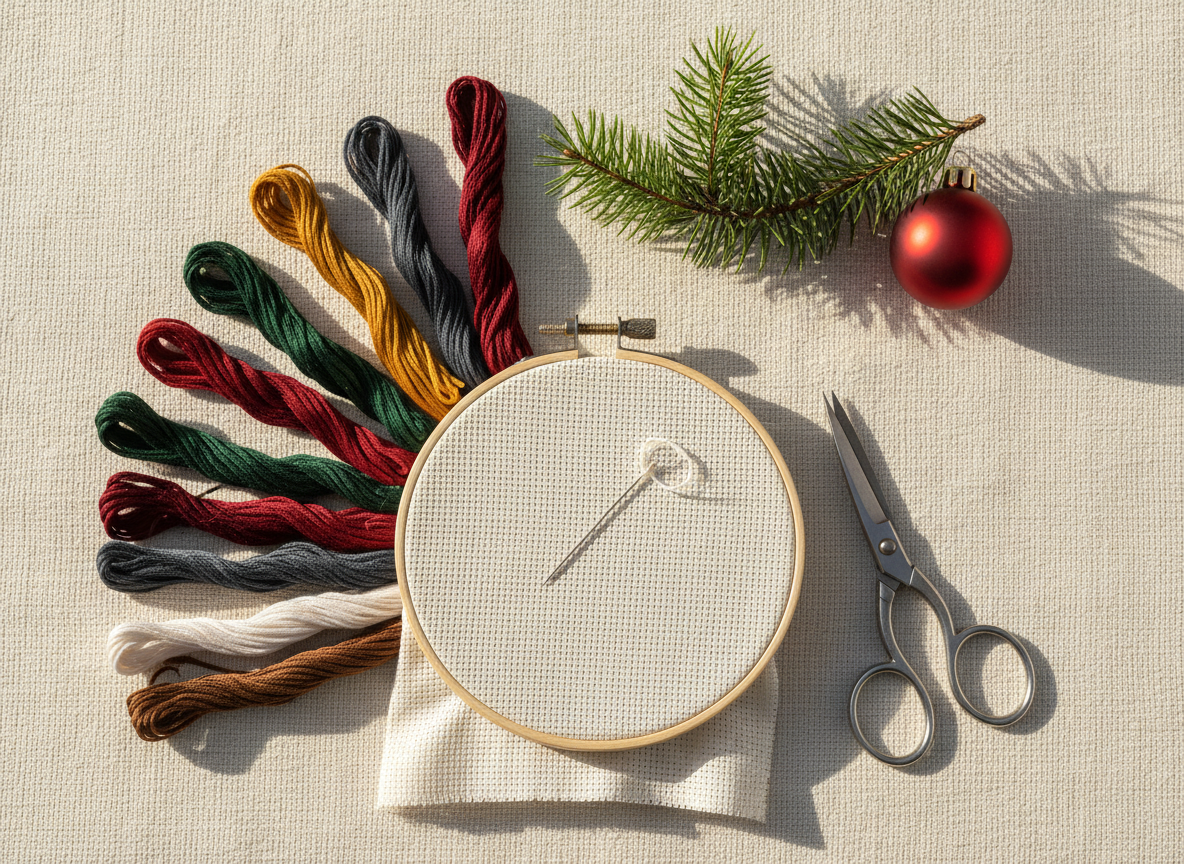
- Stage 1 — verify the download: open both PDFs, count chart pages, locate the legend, check any overlap rows and confirm whether specialty stitches or backstitch appear.
- Stage 2 — size and organize: choose fabric count, add your finishing allowance, secure edges and label threads with the actual keys supplied by the designer.
- Stage 3 — establish the scene: locate the three main motifs, count from clear grid coordinates and finish a small section of the cat or tree that gives you a trustworthy anchor.
- Stage 4 — protect delicate details: finish facial highlights, the wineglass and any tree ornaments with periodic chart checks, then apply charted backstitch where required.
- Stage 5 — inspect and display: verify completed symbols, treat the textile according to the materials’ care instructions, and mount it in a correctly sized hoop or frame.
If you’d like to calculate a deadline, time yourself for several normal stitching sessions, including color changes and counting. Use the pace from those sessions—not a universal “stitches per hour” number—to estimate your own progress. You cannot infer the true number of completed crosses from the outer grid rectangle alone.
Common mistakes with cat-and-tree holiday scenes
Mistake: buying a tiny ornament hoop because the theme is Christmas
The 135-stitch width means the design spans almost ten inches at 14-count. It may work beautifully as framed wall art, but it won’t automatically fit a tiny tree ornament. If you want several small hanging decorations instead, select a genuinely smaller chart. The cross stitch Christmas ornament finishing tutorial explains how to plan a suitable small-chart finish.
Mistake: assuming fewer colors means a faster project
A ten-color picture can still include frequent thread swaps, closely spaced highlights or unstitched gaps requiring careful counting. Examine a sample section at print scale. Does one line contain clean blocks or lots of scattered symbols? Work accordingly. You can use our guide to managing scattered stitches even though the example subject is floral.
Mistake: replacing the PDF with a listing mockup
A styled photo is useful for deciding whether you like the humor, but it isn’t a reliable counted chart. Printer scaling, thread-rendering effects and display lighting can all change what you think you see. Always count from the original symbol grid. If you’ve misplaced a motif, consult our cross stitch error-correction guide before pulling out an entire section.
Mistake: carrying dark thread behind pale fabric
A long float across an unstitched or light-colored area can show through the front, especially on cream or white Aida. Secure the end behind completed stitches and restart closer to the next dark area. This is especially relevant when the cat’s darker features are separated from the tree.
Four ways to finish a funny Christmas cat project
1. A simple square frame
A square frame feels tailored to the seller’s 135 × 135-stitch format. Use a mount and aperture that reveal the full stitched design with breathing room, not merely a frame whose advertised outside dimension matches the calculated stitched width. For delicate work, consider textile-safe, reversible mounting methods and avoid flattening raised stitches against glass. Our cross stitch framing guide covers common layout and mounting decisions.
2. A wood hoop for a cozy craft corner
A medium-to-large hoop can create a casual handmade look, particularly with natural linen and pine greenery. Check the circular hoop’s actual usable diameter against the square stitch boundary. A round opening can cut off square corners if you buy a hoop that seems equal to the pattern width. Keep enough fabric behind the hoop to finish the back neatly.
3. A humorous adult gift
This theme is particularly suited to a cat-loving friend who enjoys dry Christmas humor. Wrap the finished piece in tissue paper and include care notes rather than presenting the PDF file itself as a gift for redistribution. Respect the designer’s use terms if you plan to sell finished items or share the chart.
4. A holiday gallery wall
Mix a funny cat print with one or two calmer winter textiles, a simple snowflake and pine-green accents. Keeping the companion pieces quieter lets the cat and wineglass remain the focal point. The Christmas cross stitch inspiration guide is a useful way to choose projects with a consistent theme and finish.
Choosing gifts and other cat-themed Christmas embroidery
If the recipient loves a festive animal theme but isn’t drawn to wine humor, consider a more traditional motif: a robin, a Christmas tree or a cat beside winter books. Our Christmas book-tree stitching guide covers a bookish alternative, while the small handmade Christmas gifts plan is helpful when you’re making several presents.
For a project that can be completed as an ornament rather than a large framed display, look for clearly listed stitch dimensions under roughly 60 stitches per side, then calculate the real fabric size. This is only a planning suggestion, not a guarantee that every 60-stitch chart will suit a given ornament. Leave room for borders and finishing.
Questions stitchers ask about this Christmas cat PDF
How many stitches is the Christmas cat with wine pattern?
The seller reports a design boundary of 135 × 135 stitches. This gives 18,225 chart positions, but the actual number of stitched crosses could be lower if some background is left blank. The seller’s public description does not provide a verified total of worked crosses.
How many colors does the pattern use?
The Etsy description states ten colors. The precise DMC or other floss codes are not confirmed by the public listing text examined here. Use the actual PDF’s thread key before purchasing skeins.
What is the finished size on 14-count Aida?
At one cross per Aida block, 135 ÷ 14 = approximately 9.64 inches (24.5 cm) in width and height. Add fabric separately for framing, hooping and handling.
Can I use 16-count or 18-count Aida instead?
For normal one-over-one full cross stitch, the same chart measures about 8.44 inches square on 16-count and 7.5 inches square on 18-count. Check any specialty stitches and specific designer recommendations before substituting.
Is the cat wine design beginner-friendly?
It may be approachable for a patient beginner comfortable reading symbols, but ten colors alone doesn’t determine difficulty. Assess the actual chart’s face details, glass outline, scattered ornaments and any backstitch. A smaller single-motif practice chart may be a useful warm-up.
Does the listing include a physical kit or a stitched decoration?
No. The seller identifies it as a digital cross stitch pattern with two PDF files, not fabric, floss, hoop or a completed embroidered item.
Can I download this commercial pattern from XStitchPattern?
No. This article is an independent educational stitching and finishing guide, not a distribution of PixelToStitchCo’s copyrighted PDF. The reference design is sold by the Etsy seller, and the images in this article are separate original editorial illustrations rather than the actual pattern preview.
Make a playful Christmas cat piece that looks polished
The charm of this scene is in its balance: an expressive cat, a recognizable wine glass and a festive tree. Because the listed design measures 135 stitches per side, choosing the right Aida and display size is a bigger decision than a tiny mockup might suggest. Start with the real symbol key, check the delicate features at chart scale and choose a frame or hoop worthy of the finished piece.
If you like a festive cat theme but prefer yarn and a hook to counted stitches, our Christmas cat ball crochet amigurumi guide explains the separate craft of making round three-dimensional cat ornaments. That crochet PDF is by another Etsy seller and is not part of this cross stitch pattern.
For more ideas, browse our cat cross stitch project guides و Christmas ornament planning guide. To receive future tutorials and free-pattern news, join the XStitchPattern Stitch Studio. The newsletter and any free patterns are separate from the paid Etsy design.