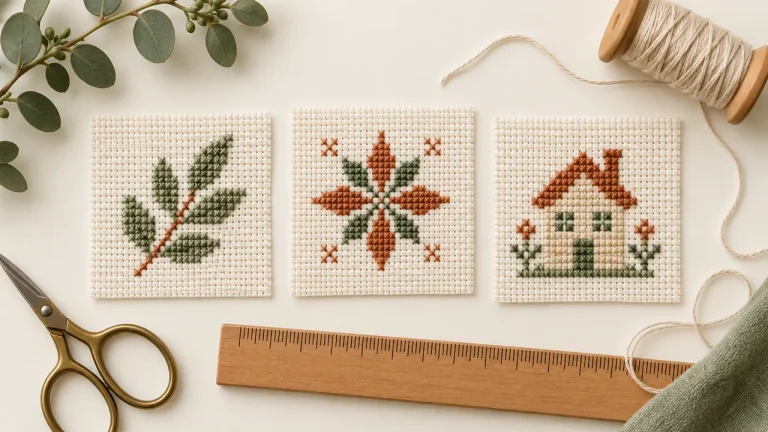

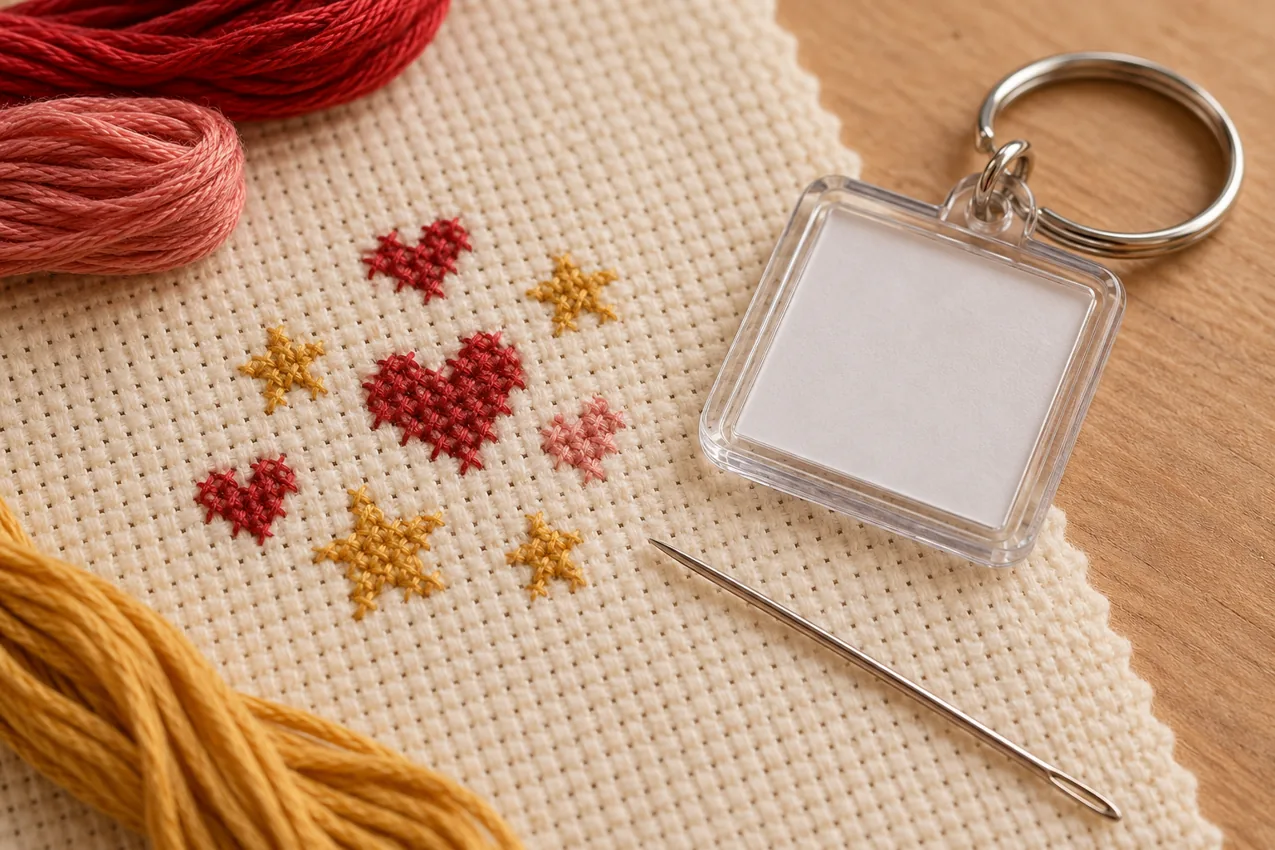
Tiny cross stitch patterns are useful for keyrings, small pendants and other inserts where only a small window of fabric will be visible. The difficult part is often the finish rather than the stitches. A motif can fit inside the outer casing yet disappear behind its rim, or a thick folded backing can stop the case closing.
In this guide
- Measure the insert before choosing a chart
- Distinguish three separate measurements
- Convert the window into stitches
- Choose motifs that survive reduction
- Stitch with enough cloth to hold
- Dry-fit, then trim gradually
- Tiny project questions
Measure the insert before choosing a chart
Use the insert manufacturer’s dimensions and instructions first. This guide explains how to translate the visible area into chart space. It does not promise that every craft insert is suitable for fabric. If you want more generous working space, compare our mini project ideas.
Distinguish three separate measurements
Measure the outer case, the internal recess and the visible window. Only the visible window tells you how much stitching can be seen. Curved corners can hide the extremities of a square chart, so trace the window on paper and test the design inside that shape.
Next check the available depth. Aida, crosses, secured thread ends and any backing all contribute thickness. Test the materials with a scrap before stitching the real motif. Never force a snap closure over bulky fabric: you may distort the design, break the case or make it impossible to reopen without damage.
Convert the window into stitches
Suppose a rectangular window is 25 mm wide. That is approximately 0.984 inches. On 14-count Aida, a 12-stitch-wide motif measures about 21.8 mm, leaving roughly 1.6 mm of visible space on either side when centered. A 14-stitch motif measures 25.4 mm and would already be too wide for that window before any breathing room.
This example assumes one full cross over one Aida square. Measure the actual fabric count if precision matters, and allow for the mounting method. The cloth must extend beyond the visible motif into whatever area the insert grips. Do not cut the fabric to the motif dimensions. Our size guide explains the underlying calculation.
Choose motifs that survive reduction
A tiny heart, simple star or bold leaf can remain readable with few squares. Detailed faces, tiny text and subtle shading are less forgiving. Choose a chart intentionally drawn at the required scale instead of shrinking a large photograph or omitting every other row.
Full crosses and a modest palette make tiny work easier to follow. Check whether backstitch extends outside the counted crosses, since it also needs to fit inside the window. Blank background can help the motif stand out, but keep carried thread from showing through that unstitched area. For an actual starting grid, try our free beginner mini charts.
Stitch with enough cloth to hold
Keep the fabric large enough for your hoop or preferred grip while working. Mark the planned window and center with temporary basting outside the final visible area. Stitch the motif, secure the ends neatly and inspect the back for lumps. Keep the top legs of the crosses consistent so the small design catches light evenly.
Follow the chart’s strand count, then test coverage if instructions are absent. Extra strands can make a tiny insert too thick even when they improve front coverage. DMC’s cross stitch resources explain basic materials and stitches. A sample on the actual cloth gives more useful information than a digital preview.
Dry-fit, then trim gradually
Complete any appropriate care before mounting, and make sure the fabric is fully dry. Position the motif behind the window and check it from the front. Only then trim in small steps to the insert’s recommended outline, keeping enough cloth for a secure fit. Do not assume every corner needs the same fold.
Use adhesives only if the insert maker calls for them and you have checked compatibility with the textile and intended use. An inexpensive keyring is a handled craft object, not archival framing. If you want a reversible display for a valuable piece, choose a different finish. Keep one completed sample and test normal handling before making a whole batch of gifts.
Tiny project questions
Will 18-count Aida help? It makes the same chart physically smaller, but the holes and stitches are smaller too. Confirm that it remains comfortable to work.
Can I wash an assembled keyring? Follow the casing and thread instructions; moisture trapped inside a case can cause problems.
Is a tiny pattern always quick? No. Confetti, frequent changes, outlines and mounting can take longer than the motif’s size suggests.