
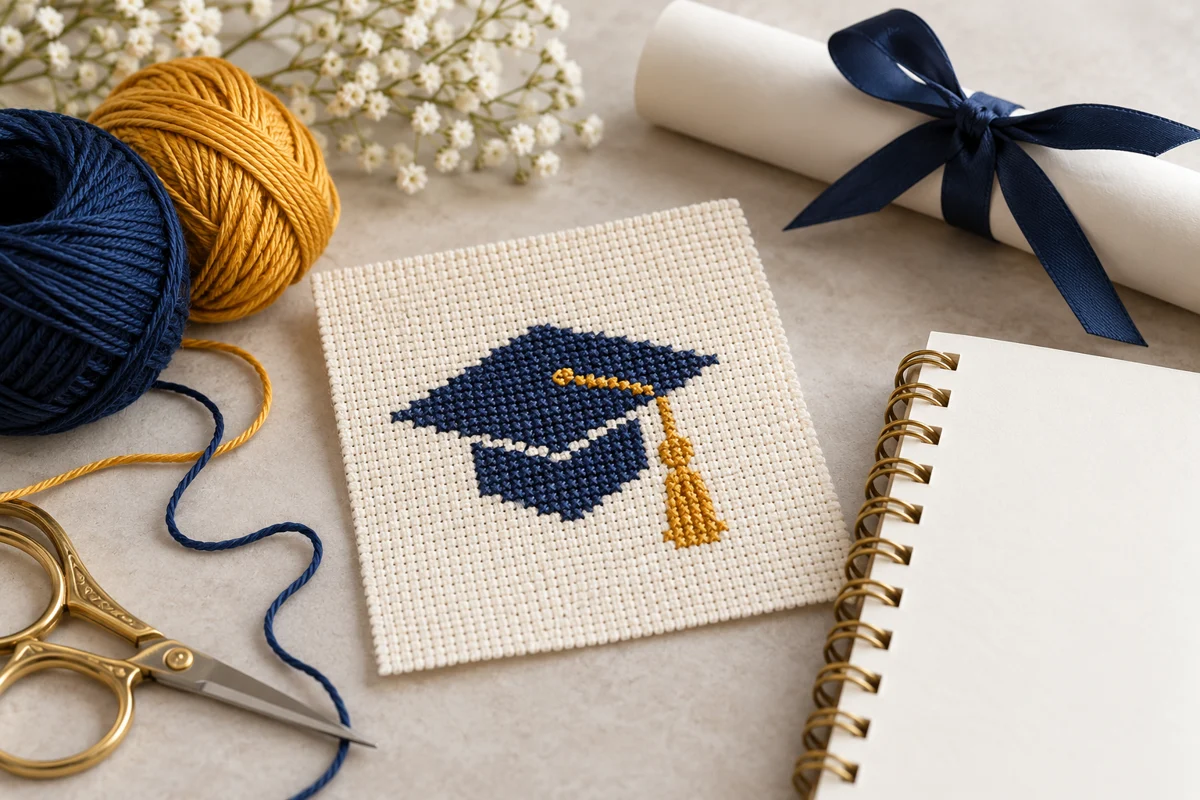
Graduation cross stitch patterns are most successful when the graduate’s name, year and ceremony details are checked before stitching begins. A compact cap motif, book design or personalized sampler can mark the milestone without requiring a huge project. Confirm the actual ceremony date, then plan the finished object and the charted lettering together.
Planning note: Dates depend on the school and ceremony; confirm the recipient’s 2027 date.
Proof the information before charting it
Ask for the graduate’s preferred name and confirm the year to be stitched. If you include a degree title, institution or qualification, copy the approved wording rather than shortening it from memory. A small error in a personalized sampler can be more noticeable than a missing decorative stitch.
Choose a charted alphabet with numerals and punctuation that match its style. Count the entire line, including spaces and the gap between a name and date. If you use an institution’s crest or logo, choose a licensed chart or an original general motif; a school’s colors do not require copying its protected emblem.
Balance the name and motif on a real grid
A short name and a long name rarely occupy the same width. Sketch the complete arrangement before deciding where the center lies. You can put the name on a separate line or simplify the surrounding border, but do not squeeze letters by removing important squares from their forms.
For example, a sampler 84 squares wide measures 6 inches on 14-count Aida. A 70-square version measures 5 inches on the same cloth. Add the mounting allowance separately and check the actual frame opening, especially if a tassel, border or backstitched line extends outside the main block of crosses.
Leave room for the finish and the celebration
Graduation dates vary by institution and country, so there is no single reliable 2027 date for all recipients. Confirm the ceremony, party or mailing deadline directly. If you want to present the work at the event, finish and mount it before the busiest final week rather than planning to stitch until the night before.
A small frame or card can travel more easily than a large stretched textile. Keep the reverse neat, support the fabric and package the piece so any glazing or backing does not press unevenly into the stitches. If the graduate is moving, consider whether a small portable keepsake would be more useful than a large display.
Before you begin
- Read the actual symbol chart, thread key and stitch-type notes.
- Calculate the design area and add the allowance required for your chosen finish.
- Test the intended cotton and fabric together on an offcut.
- Keep a readable working copy and check the first completed motif before repeating it.
Questions and next steps
Should I use the graduation year or ceremony date?
Use the information the recipient wants to remember. Academic completion and ceremony dates can differ.
Can I change the tassel to school colors?
A tested color substitution may work, but keep the chart symbols and contrast clear. Confirm the desired colors first.
Is a graduation gift only suitable for university?
No. Match the wording and design to the actual milestone, whether school, training or another qualification.
For practical preparation, see centering charted names, and calculating a sampler’s fabric size.
For another seasonal project, explore Father's Day Cross Stitch Patterns or Wedding Cross Stitch Patterns. Choose a chart that is actually supplied or available to buy; this selection guide does not promise a new downloadable pattern.
For general counted-stitch and fabric guidance, see DMC’s cross stitch introduction.
 English
 French
 Spanish
 German
 Arabic