
أ celestial cats cross stitch pattern brings several delicate subjects together: the personality of two cats, the curve of a crescent moon, tiny stars and a loose ring of flowers. For a spooky-cute variation featuring a nighttime cemetery, see our gothic Halloween cottagecore cross stitch guide. The result can feel both witchy and gentle—more like a botanical night-sky keepsake than a conventional spooky Halloween decoration. But those details also ask for careful decisions about fabric, dark outlines and how small motifs sit around the animals.
ال “Celestial Cats – Witchy Floral Design” PDF by CrossStitchWithArt is sold under the design name Mystery Cats. Its seller reports a 98 × 97-stitch chart, 13 DMC colors and an approximately 7 × 7-inch result on 14-count Aida. The seller’s download description also specifies three PDFs and one ZIP, with color and black-and-white charts. We’ll work from those declared specifications, not guess the stitch count from mockups. This is an independent educational guide, not the commercial chart or a copy of its artwork.
The appeal of a witchy floral cat embroidery design
In this niche, “witchy” need not mean scary. Small moons, stars, night-sky blues and wildflower shapes create an atmospheric mood that suits gothic cottagecore, a cozy reading space and year-round cat-lover gifts. Unlike a large photorealistic cat portrait, a celestial motif is often read as a collection of shapes: the cats provide warmth, the moon gives direction, and the flowers soften the composition. For a gentler daytime cat-and-flowers design, explore our floral kitten cross stitch guide.
The tricky part is keeping that hierarchy readable. Viewed from across the room, you should first notice the pair of cats, then the crescent moon and finally the delicate botanical accents. If every flower and star is equally bright, the outlines of the cats may lose their visual importance. When stitching a purchased chart, preserve the designer’s planned spacing rather than adding extra stars into every empty area.
Look for three clearly defined visual anchors
- The cats: identify the ears, tail positions and the space separating the dark and lighter animal. Small face details deserve particular attention.
- The crescent moon: follow the outer and inner curve carefully. A single missing cross at a narrow tip can change the apparent shape.
- The floral surround: make sure stems and petal clusters are separate from the cat’s fur and the moon, especially where orange flowers meet warm brown markings.
If you enjoy comparing compositions, our cat pose and silhouette guide explores how ears and tails establish a readable shape. For a different balanced arrangement using two cats, see our Yin Yang Cats stitching guide; that article focuses on the circular relationship between two bodies rather than floral and celestial details.
What is included in the Mystery Cats PDF?
The public Etsy description identifies the designer’s project as an intermediate-level pattern, though it also calls the symbols and color blocks beginner-friendly. The listing includes an instant digital download described as three PDF files and one ZIP. It says full-color and black-and-white charts are included and advertises compatibility with Xodo, Adobe Reader and Markup R-XP. Compatibility is the seller’s claim; it has not been independently tested here. Nothing in this article includes the purchased chart or grants redistribution rights.
| Listing detail | Seller-reported specification | What to inspect after downloading |
|---|---|---|
| Design grid | 98 stitches wide × 97 high | Printed coordinates, any page overlaps and true stitched area |
| Finished size | About 7 × 7 inches on 14-count Aida | Mounting margin, visible picture and frame aperture |
| Palette | 13 DMC colors | Exact floss numbers, amounts and symbols in the PDF key |
| Download | 3 PDFs + 1 ZIP | Which versions are color/black-and-white and where each chart page belongs |
| Difficulty | Intermediate, with beginner-friendly chart presentation | Backstitch, fractional stitches and scattered details if present |
| Use terms | Personal use; no chart redistribution or resale | Any additional license rules supplied in the files |
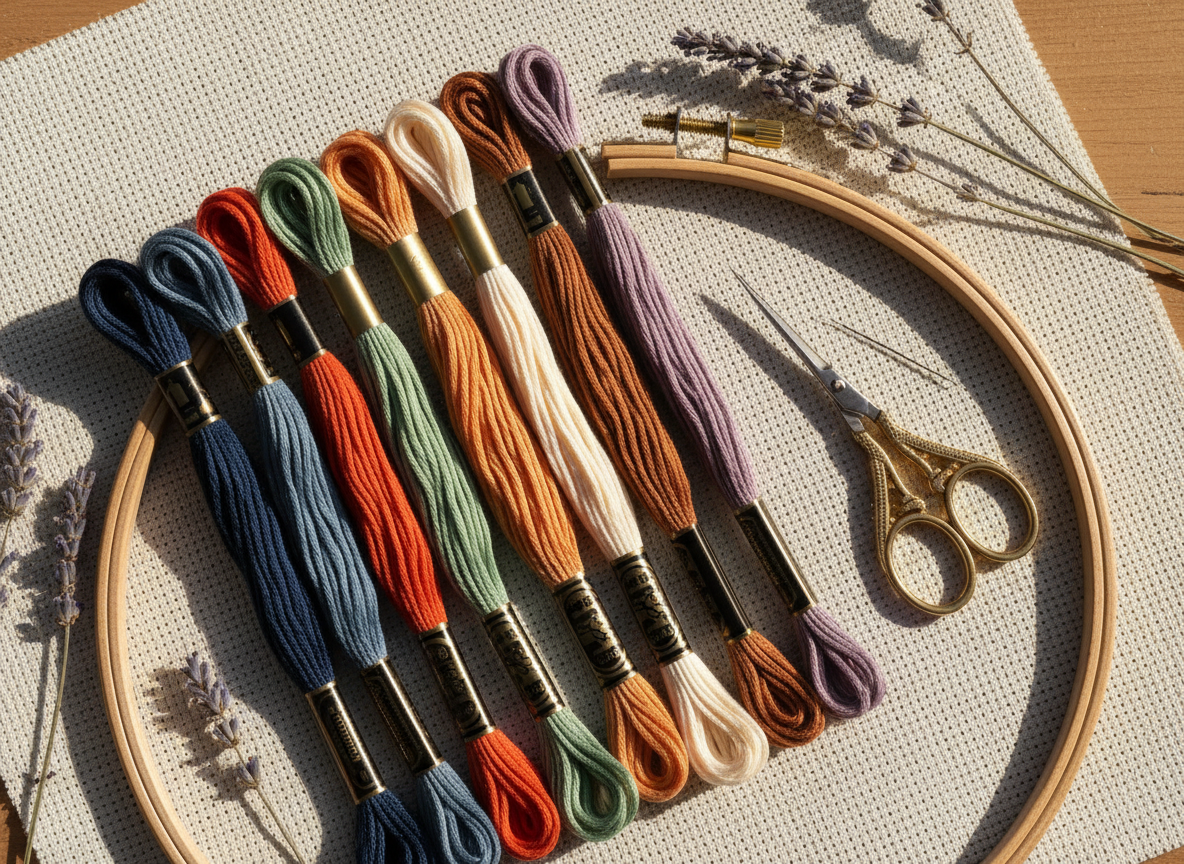
The description names hues such as burnt orange, pumpkin, navy blue, pistachio and coffee brown. Those are color families, not enough information to identify the exact DMC numbers. Buy floss from the PDF’s thread key, not from a palette guessed by an article or an image generator.
Also check whether the PDFs are multiple views of one pattern or separate instructions. Several files do not automatically mean several different designs. If the downloaded ZIP contains images, treat them as reference material until you verify their intended purpose and the seller’s instructions.
Calculate fabric from the actual 98 × 97-stitch chart
Fabric planning is one place where this listing gives enough information for precise math. On Aida worked one cross over one fabric square, stitched width = 98 ÷ fabric count و stitched height = 97 ÷ fabric count. The design is almost square but not exactly; that one-stitch difference becomes smaller on higher-count fabric.
For illustration, the cutting dimensions below add 3 inches (7.62 cm) of working and finishing allowance on each side—so 6 inches to the finished width and 6 inches to the finished height. This is a common planning allowance, not a universal framing requirement. Check your hoop, frame and preferred lacing or mounting method before cutting.
| Fabric | Stitched size (W × H) | Example cloth cut with 3-inch margins |
|---|---|---|
| 14-count Aida | 7.00 × 6.93 in (17.78 × 17.60 cm) | 13.00 × 12.93 in (33.02 × 32.84 cm) |
| 16-count Aida | 6.13 × 6.06 in (15.56 × 15.40 cm) | 12.13 × 12.06 in (30.80 × 30.64 cm) |
| 18-count Aida | 5.44 × 5.39 in (13.83 × 13.69 cm) | 11.44 × 11.39 in (29.07 × 28.93 cm) |
The chart rectangle contains 9,506 grid positions (98 × 97). That does not prove 9,506 stitches must be completed: open fabric around the crescent and flowers may remain unstitched. The exact stitched-cross count must come from the chart or floss-usage information, not the outer bounding rectangle.
Choosing between 14-, 16- and 18-count Aida
For a first intermediate project, 14-count can be comfortable because its holes are easier to identify. Sixteen-count gives a smaller, slightly finer look, while 18-count produces an even more compact result but requires more visual precision. The choice doesn’t reduce the number of chart symbols: it changes how large the same design appears on the fabric. For additional help, see how to identify your Aida count and our cross stitch fabric size guide.
If you’re planning a round display hoop, check the actual usable opening against the full 98 × 97 grid, and allow some breathing room around the flowers and moon. A hoop marked “7 inches” is not automatically large enough to show a 7-inch-wide stitched image without crowding the edges. Before ordering a special frame, lay a full-size paper rectangle on top of the proposed opening.
Choose a fabric color that supports the moon and cats
The background can strongly change the witchy feel of the design. Cream Aida can preserve light petals and let dark cat silhouettes stand out. Light oatmeal adds a vintage cottagecore mood, but coffee-brown thread and pale warm flowers may lose contrast if the fabric is too similar. Dusty blue-gray can suggest twilight, though the moon’s and stars’ light-colored stitches need testing against it.
Deep navy or black fabric may look dramatic in a photograph, but it can swallow the outline of a dark cat and make counting more demanding. Unless the pattern designer gives a specific tested recommendation for dark fabric, begin with a small swatch: work several of the darkest and lightest stitches side by side, under your normal lamp. Never assume a mockup’s fabric has been stitched and tested in exactly that color.
A quick contrast test before committing
Place your real floss skeins on the intended cloth. Take a well-lit photograph and view it in grayscale. The cat outline and neighboring moon curve should remain distinct. If two dark colors disappear into each other, study their placement in the pattern rather than immediately changing the designer’s palette. Our black cat fabric contrast tutorial covers exactly why dark-on-dark stitching can flatten the result.
Organize a 13-color celestial palette without confusion
A 13-color legend may look manageable, but the project mixes objects with very different textures. Cats need coherent fur patches, the moon needs smooth curves, and floral petals often change shade over just a few squares. Sort thread by its visual role and keep each DMC number attached to its symbol, especially where orange petal shades overlap with warm brown fur.
| Color family reported by seller | Possible visual role to examine | Practical check |
|---|---|---|
| Navy blue / dark values | Night-sky accents and deep outlines | Can you tell a star from nearby dark stitches? |
| Burnt orange / pumpkin | Warm floral petals and decorative details | Do oranges remain distinct from brown cat fur? |
| Pistachio green | Leaves or botanical stems | Are narrow stems visible against the fabric? |
| Coffee brown | Fur or warm outlining | Can the cat outline be seen beside dark leaves? |
| Pale highlights | Moon, petals or little stars as charted | Do pale stitches show on your chosen background? |
These are visual planning questions, not a reconstruction of the seller’s proprietary DMC legend. Don’t reduce the number of colors simply because two skeins look similar in a photo. A single intermediate shade may separate a petal from the background or preserve a cat’s facial expression.
The same contrast questions come up in other downloadable projects, even when their visual style is different. For a modern cat silhouette and swirling colors, explore our Purple Abstract Cat cross stitch PDF. If the moon and night-sky atmosphere are what appeal to you, the Crescent Moon Castle PDF offers a separate fantasy setting. For stitchers drawn especially to botanical details, the Wildflower Meadow PDF in color and black-and-white puts flowers at the center. These are distinct XStitchPattern downloads, not additional files or versions of CrossStitchWithArt’s Celestial Cats design.
A stitching sequence that protects the details
There is no need to force every celestial pattern into a top-left-to-bottom-right workflow. For this one, identify reliable anchor points and then move outward in connected sections. Keep a marked working copy of the PDF and note when a stitched area crosses a chart-page boundary. If the download contains both color and black-and-white versions, use the one with symbols you can distinguish most easily.
1. Begin with a trustworthy cat landmark
Find a prominent ear tip, tail curve or connected body outline that is easy to identify on the grid. Measure its distance from the chart center and from another nearby reference. Establish a small block of full crosses, then double-check the position before stitching the neighboring face or the second cat. A one-square error in an ear may be more visible than one in an irregular leaf.
2. Establish the crescent’s two edges
The moon needs accurate inner and outer curves. Mark each narrow tip on the working chart, count its distance from the closest star or cat ear, and stitch a short connected group. The steps of the pixel edge should look deliberate, not randomly jagged. Avoid “smoothing” the moon by inventing half-stitches unless the pattern itself requires them.
3. Build the larger flower and leaf groups
Work stems and groups of petals in an order that makes their relationships easy to track. A leaf at the outer edge can be a useful anchor for a cluster of little flowers. Avoid running thread long distances across the backs of unstitched pale areas to reach a single dot. Secure the thread and restart closer to a separated motif when necessary.
4. Reserve the smallest stars for a separate pass
Tiny stars often consist of only a few squares or short outline details. If you stitch them while moving between large cat sections, it’s easy to count from the wrong anchor. Instead, mark their chart coordinates and complete them in deliberate groups after the larger surrounding forms are stable. Check whether each shape uses ordinary full crosses or the chart’s other stitch types, if any.
5. Work the facial details and charted backstitch
The cats should still look like themselves when the project is viewed at normal wall distance. Compare the eyes, nose and ear outline against the chart before declaring a face finished. Apply any backstitch only where the actual key indicates it. You can use our step-by-step backstitch guide if the symbols call for that technique; don’t assume every witchy pattern uses it.
6. Audit the balance before finishing
Step away from the hoop. Can you distinguish both cats? Are the crescent tips intact? Is one part of the floral ring accidentally incomplete? Check off chart sections systematically, then inspect the reverse for long dark thread carries that may show through light Aida. If you spot a counting error, use the cross stitch error-repair guide before removing an entire motif.
How long will this project take?
No reliable completion time follows from “13 colors” or “98 × 97 stitches” alone. A design with open background and connected color blocks may be quicker than a smaller full-coverage motif with many isolated stitches. The size of the petals, the exact symbols, and whether lines require backstitch all affect the schedule. The seller calls the project intermediate, which is a useful signal to allow extra time for details.
To estimate your own timeline, complete two or three normal sessions, noting how much of the chart you cover including thread changes and re-counting. Avoid comparing yourself with an online average that counts only uninterrupted full crosses. If the design is intended as a birthday gift, start early enough to include washing or pressing if permitted, mounting and framing.
If celestial motifs are your favorite part of the craft, you can also explore the XStitchPattern Etsy shop for our own downloadable counted cross stitch projects and gift ideas. The Mystery Cats / Celestial Cats PDF by CrossStitchWithArt discussed here belongs to that independent designer; it is not a pattern included with our Etsy listings or with the three alternative WooCommerce designs linked earlier.
Mistakes to avoid with moon-and-floral animal motifs
- Buying a frame from the rounded “7 × 7 inches” label. The actual stitched height is 97 stitches, and the frame’s visible opening may be smaller than its advertised size.
- Assuming 13 colors are automatically beginner-level. Flower and star placement, overlapping dark shapes and specialty stitches can make a modest palette demanding.
- Choosing deep blue fabric without a test. Midnight-toned cat sections or dark moon detail may become nearly invisible.
- Stitching a long dark carry behind pale petals. Such threads can show through unstitched Aida.
- Counting the 9,506 grid squares as actual worked crosses. Blank background positions may not require stitches.
- Adding extra stars from the listing artwork. Follow the symbol grid and don’t silently modify a commercial chart.
- Assuming every PDF works perfectly in every marking app. The seller reports compatibility; check with the real download.
Display ideas: botanical witchy decor that works all year
An antique-look wooden hoop
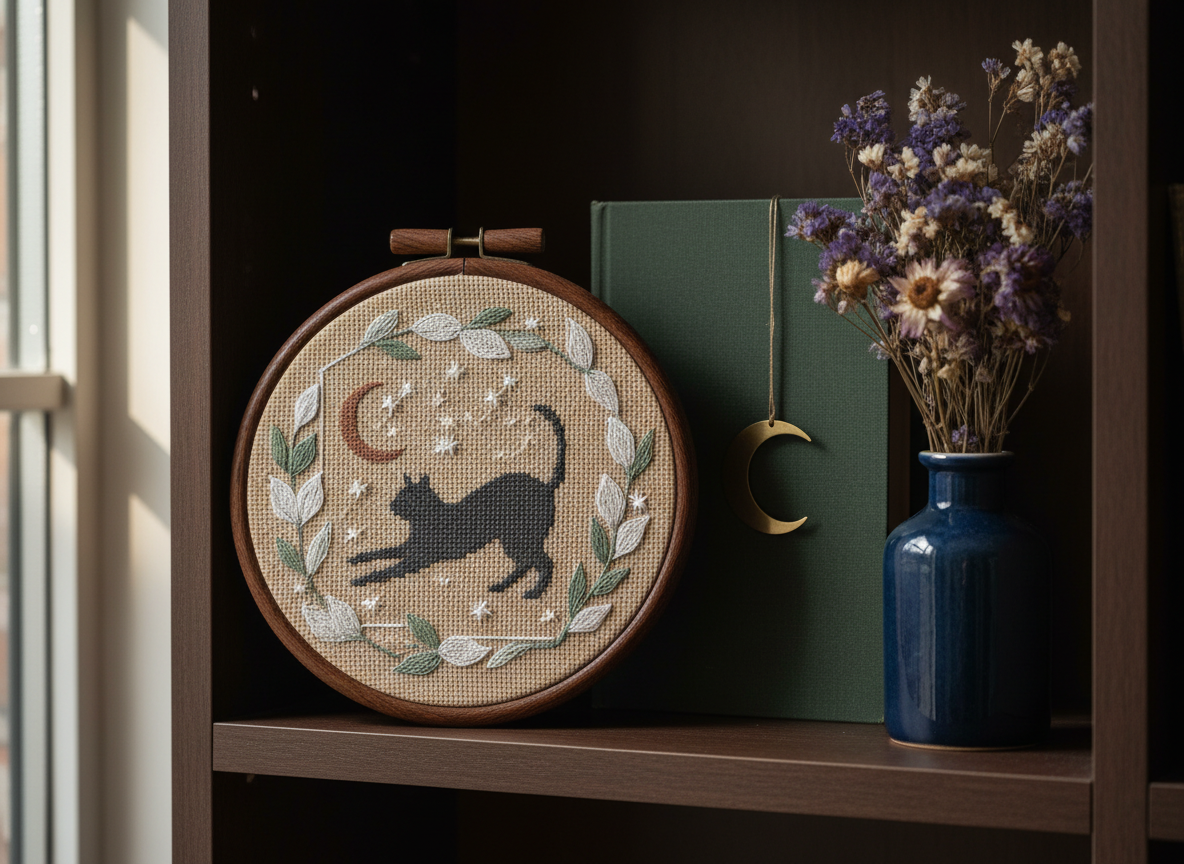
Warm wood complements pumpkin-colored flowers and brown fur, while the circle echoes the moon’s curved shape. Leave enough fabric around the design to gather or lace it at the back. For a crisp finish, consider an understated fabric or felt cover on the reverse and a small loop for hanging. Our hoop finishing tutorial covers these decisions.
A framed dark-academia shelf piece
A simple walnut or charcoal frame can lend a bookish, evening mood. Mount the embroidery on suitable textile-safe backing so the stitching isn’t pressed hard against glass. The chart’s stitched area is about 7 × 6.93 inches on 14-count; use a mount opening slightly larger than the visible stitched design when appropriate, and confirm the framer’s recommended margins.
A gift for a cat lover who likes moon motifs
This subject is particularly suited to a cat lover drawn to gentle gothic cottagecore, celestial art and flowers. You can present it as a finished stitched piece along with basic care guidance. The Etsy listing restricts redistribution or resale of the pattern itself; don’t include copied chart pages as bonus material or list the design as your own copyrighted artwork.
Seasonal styling without turning it into Halloween-only decor
A few dried flowers, a deep-blue textile or a small brass moon ornament can evoke the night sky year-round. In autumn, you might pair the hoop with natural acorns; in spring, emphasize the pistachio greenery and petals. The piece doesn’t require pumpkins, bats or other Halloween symbols to feel magical.
Questions about the Celestial Cats PDF
What size is the Celestial Cats cross stitch pattern?
The seller lists 98 × 97 stitches, approximately 7 × 7 inches on 14-count Aida. More precisely, 98 ÷ 14 = 7 inches and 97 ÷ 14 ≈ 6.93 inches, before mounting margins.
How many DMC colors does Mystery Cats use?
The Etsy listing says 13 DMC colors and mentions burnt orange, pumpkin, navy blue, pistachio and coffee brown among the palette families. Exact DMC codes and floss quantities are in the purchased chart’s key, not verified here.
Is the pattern suitable for beginners?
The seller describes it as intermediate yet also beginner-friendly in its chart presentation. A confident beginner familiar with reading PDF symbols and tracking small gaps may enjoy it, but inspect the real legend for any backstitch or fractional stitches before choosing it as a first project.
Can I stitch it on 16- or 18-count fabric?
For standard one-cross-per-square counted work, the same 98 × 97 grid would measure roughly 6.13 × 6.06 inches on 16-count Aida and 5.44 × 5.39 inches on 18-count. Confirm any specialty stitches and the designer’s fabric recommendations before changing counts.
Are black-and-white and color charts included?
The seller says both formats are included within the digital download, which is described as three PDFs and one ZIP. Check your purchased files to see which versions are one-page versus multi-page, and use the one that’s most readable for you.
Can I use Xodo, Adobe Reader or Markup R-XP?
The Etsy description advertises compatibility with these programs. That statement comes from the seller and isn’t a guarantee independently tested here. Check the downloaded file’s practical behavior in your chosen reader or tracking application.
Does this article include the paid PDF chart for free?
No. The copyrighted commercial chart belongs to CrossStitchWithArt. This article provides original educational planning, stitching and finishing advice; its editorial images are separate concept illustrations and are not accurate copies of the stitch grid.
Make room for a little night-sky magic
The strength of this pattern is its combination of recognizable cats, a clear crescent moon and a delicate botanical surround. With a precise 98 × 97-stitch size, you can plan fabric confidently rather than guessing from styled photos. Keep the symbol key nearby, give flower and star details their own checkpoints, and choose a fabric that protects both dark fur and pale moon highlights.
For your next animal or fantasy project, explore our cat cross stitch guide, moon-and-castle fantasy stitching ideas, or floral cross stitch composition advice. To receive new tutorials and free-pattern news, join the XStitchPattern Stitch Studio. The newsletter is separate from the paid Etsy PDF.