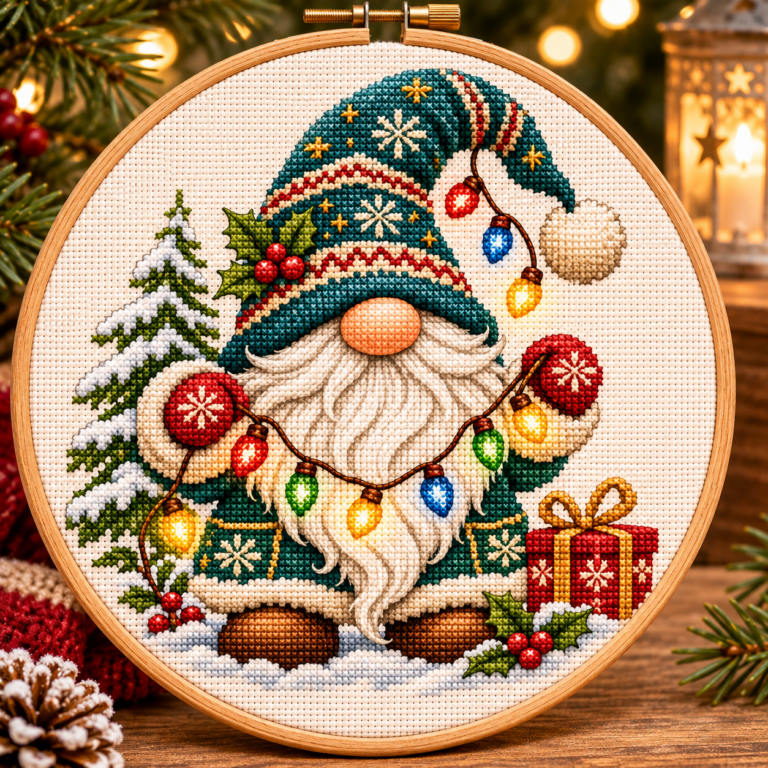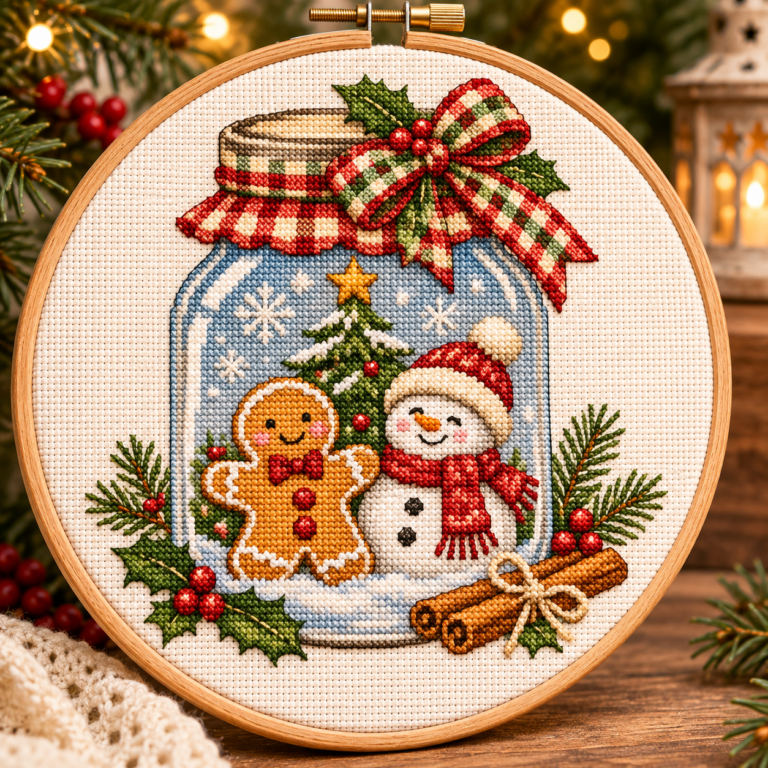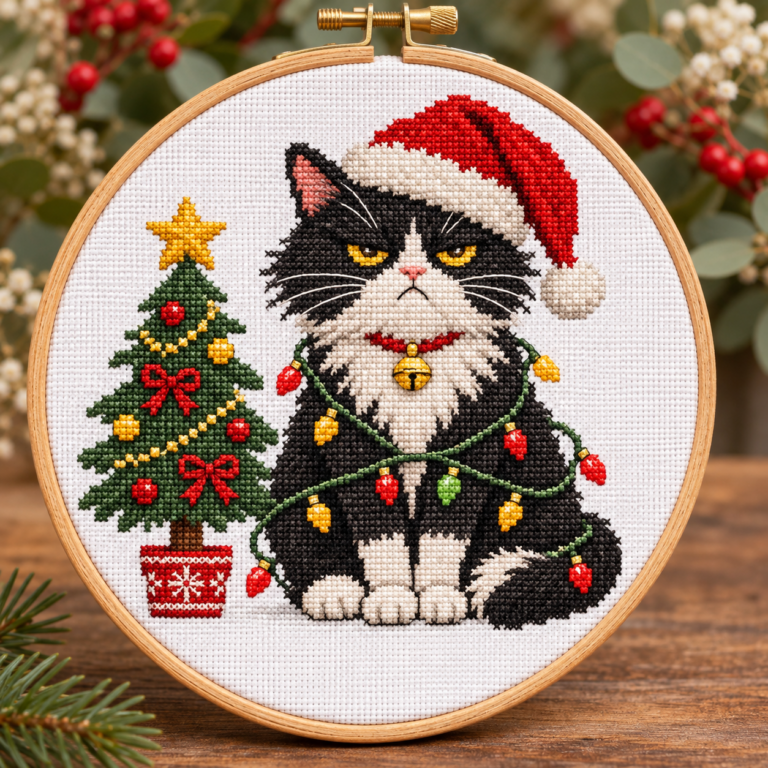

Small hats, oversized beards, rosy noses and a surprising amount of personality: gnomes make wonderfully characterful counted cross stitch projects. A tiny gnome can brighten a handmade card or ornament, while a larger gardener, baker, winter traveler or craft-room companion can become a framed gift. Today it is easy to find cute gnome cross stitch patterns as instant PDF downloads, but picking a design that looks lovely and stitches comfortably takes more than clicking the first charming picture.
Here you will find a practical, year-round guide to gnome pattern styles, reliable digital-download checklists, sizing on 14-, 16- and 18-count Aida, ways to manage hats and beards, seasonal gift ideas, and finishing methods. We also compare what a real seller states with what a mockup only suggests, so you can decide which chart suits your supplies, experience and schedule.
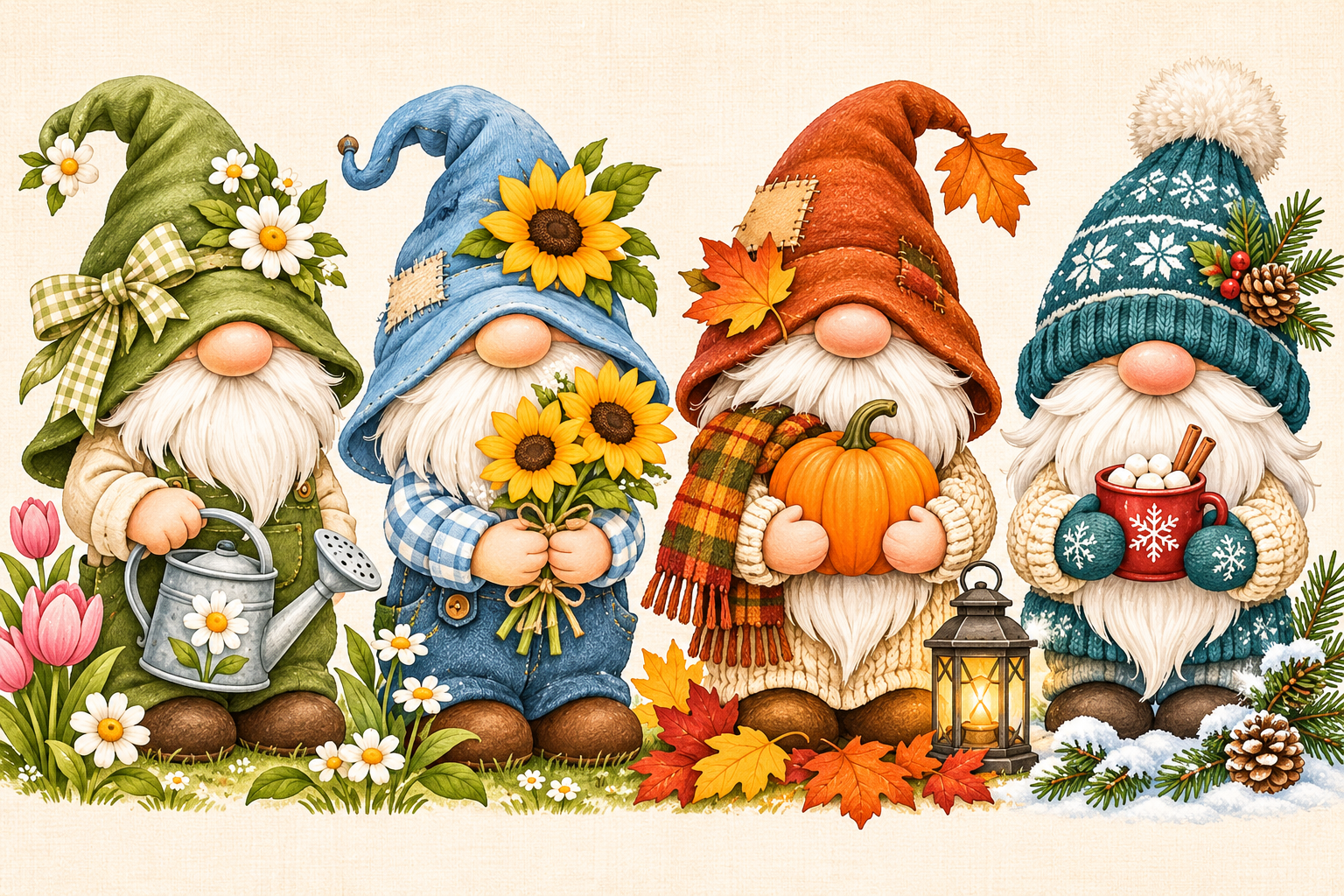
Artwork note: the four gnomes pictured above are an original editorial illustration created for XStitchPattern. They are not photographs of finished stitching and have not been converted into four downloadable cross stitch PDFs. The downloadable products mentioned below have their own individual listings and descriptions.
What the Cutebroidery reference actually offers
The supplied Cutebroidery reference link currently opens the shop’s main page rather than a unique pattern identified by the pin_id parameter. From that homepage visitors can reach the independent Cutebroidery gnome collection, which includes seasonal and profession-themed counted cross stitch charts. The site presents its products as digital PDFs with instant delivery; it also advertises a newsletter welcome gnome on the homepage. The welcome offer is Cutebroidery’s, not an XStitchPattern freebie.
It is important to distinguish a collection from one pattern. A collection can contain hundreds of different designs with different sizes, thread lists, levels of detail and file contents. Do not transfer a color count, page count or stitch measurement from one gnome listing to another. In particular, the supplied homepage link does not identify a specific chart that XStitchPattern owns or is authorized to distribute.
For a verifiable example from the other shop, its Sewing Gnome PDF listing describes a 103 × 125-stitch chart, 26 colors and a finished design area of approximately 18.7 × 22.7 cm on 14-count fabric. The listing describes several color and black-and-white symbol-chart views. Those figures belong to that one third-party design only. They are not specifications of our illustration, an XStitchPattern product or every gnome PDF in the collection.
The cutest gnome cross stitch themes to choose from
1. Spring gardener gnomes
Think watering cans, tulips, daisies and soft green hats. Garden gnomes work especially well for spring cards, housewarming presents and little framed pictures on a potting bench. To keep a small motif readable, give the watering can and the hat two distinctly different silhouettes and allow a little untouched cloth between flowers and beard. Delicate white blossoms need enough contrast when stitched on pale Aida.
A gnome surrounded by many thin stems may look airy in a full-color digital image but turn into a dense tangle when reduced to a small counted grid. If you are purchasing a miniature chart, inspect the actual pattern preview for clear petal edges rather than judging by a lifestyle photograph.
2. Summer sunflower and beach gnomes
A blue hat, bright sunflower, citrus fruit or a tiny beach accessory can make a cheerful summertime design. These are good candidates for color-forward stitching, particularly when the main objects are arranged in separate blocks instead of confetti-like single stitches. A sunflower often benefits from a darker center and recognizable ring of petals, while a beach scene needs enough contrast between light sand, pale beard and white Aida.
Summer patterns are also convenient travel projects when they require only a small thread organizer. Choose a chart with manageable page size and clear symbols, and keep the pattern saved where you are permitted to use it offline.
3. Autumn pumpkin and woodland gnomes
Pumpkins, falling oak leaves, mushrooms and knitted scarves make charming fall décor. Autumn gnomes look especially cohesive when the hat, beard, boots and accent object remain visually separate despite their warm shades. Rust, brick, copper and brown can be beautiful together, but too many similar values may hide the folds of a hat or the edge of a tiny pumpkin.
If autumn is your favorite season, see our mini autumn cross stitch planning guide for additional small motifs to pair with a gnome. A coordinated ornament set is often more practical than one large project when you need multiple gifts.
4. Winter and Christmas gnomes
Snowflake hats, pinecones, berries, lanterns, hot cocoa and robins all work with the signature gnome shape. Festive designs are ideal for handmade ornaments, but remember that the making deadline includes both stitching and finishing. If a 200-stitch-wide gnome is your first substantial project, plan well ahead of the holiday rather than relying on a “quick gift” label.
We already have dedicated articles on woodland winter gnome cross stitch planning, the snowy Christmas gnome with robin, and a gnome holding a robin and lantern. Those deep dives are specifically about winter projects. The present guide is broader: it helps you compare different gnome themes and choose the right kind of instant-download PDF in any season. For a specific colorful example, our Christmas gnome with lights cross stitch guide explains the 84 × 122-stitch pattern and Aida sizing.
5. Hobby and profession gnomes
One of the most personal gift ideas is a gnome holding something that reflects the recipient’s interests: a needle and thread, cookbook, paintbrush, fishing rod, book or gardening tool. These accessories give the design a story without needing text. At small sizes, pick one identifiable prop rather than three that will become indistinct. It is more satisfying to stitch an unmistakable sewing gnome than a miniature collage of needles, spools and scissors that loses definition.
What instant-download cross stitch PDFs should include
An instant-download file should be something you can actually follow to make stitches, not merely a printable picture. A legitimate chart generally includes a counted grid, a symbol legend and color information, plus any special stitch instructions. Some commercial designers provide multiple versions such as color-symbol and black-and-white charts; others offer only one. Neither format is automatically superior, but the description must accurately identify what is included.
| Before purchasing | Chercher | Why it matters |
|---|---|---|
| Delivery | Clearly described digital PDF access | Know when and where you can open the chart |
| Dimensions | Width × height in stitches | Calculate the actual design size |
| Thread legend | Brand or color system, symbols, strands | Prepare appropriate floss |
| Chart views | Symbols, possible black-and-white view | Read the pattern in your preferred format |
| Backstitch | Clear indication if present | Important for hat seams and details |
| Page layout | Numbered multi-page chart if necessary | Avoid losing position at page edges |
| License | Usage and redistribution terms | Respect the pattern designer’s rights |
| Product format | PDF-only versus physical kit | Avoid expecting fabric or thread in the mail |
Do not interpret the phrase “instant download” as “instantly ready without any supplies.” A digital chart may arrive immediately after purchase, but you still need the correct fabric, floss, needle and a suitable finishing plan. A designer’s photograph may show decorative props not included with a chart-only purchase.
Be cautious with claims of compatibility with particular chart-tracking apps. A PDF that opens in a reader is not necessarily optimized for every tracking program. Unless the actual seller tests and specifies support, treat that feature as unverified. Likewise, “beginner friendly” on a listing does not tell you how many isolated stitches, backstitch lines or pages you will have to manage.
Free gnome charts versus paid PDFs
Free charts are useful for trying counted cross stitch and practicing a small shape before tackling a larger design. The best ones come directly from a designer or manufacturer and include legible symbols. A premium PDF may provide a more elaborate illustration, detailed material instructions or an art style that you particularly love. Neither price nor the number of patterns in a bundle guarantees clarity.
If a page offers a free gnome after newsletter signup, read the conditions and confirm what is delivered. Our own free-pattern newsletter signup is separate from any third-party store’s membership or welcome offer. Do not assume that signing up here provides Cutebroidery’s files or that a displayed editorial gnome image has an associated PDF download.
Ask yourself whether you really want five related gnomes or one specific illustration. A bundle can be economical for repeat gifting if each component is usable, but a single easy-to-read PDF is often the better starting point for someone testing a new fabric count. Our year-round cross stitch pattern hub compares the practical differences between free charts and premium pattern libraries.
How large will a gnome cross stitch be on Aida?
Counted cross stitch size is determined by the number of chart squares and the count of the cloth. For a design stitched over one Aida square per full cross, divide the chart width and height in stitches by the Aida count to get inches, then multiply by 2.54 for centimeters. That calculates the design area, not the fabric cut required for framing or mounting.
As an illustrative example rather than specifications for this artwork, imagine a gnome chart that is 80 stitches wide and 110 stitches high:
| Fabric count | Stitched size (in) | Stitched size (cm) |
|---|---|---|
| 14-count | 5.71 × 7.86 | 14.51 × 19.96 |
| 16-count | 5.00 × 6.88 | 12.70 × 17.46 |
| 18-count | 4.44 × 6.11 | 11.29 × 15.52 |
For a framed piece, you will normally need extra cloth on every side. Around two to three inches per side is a common starting allowance, but the exact amount depends on the frame and mounting technique. For a small round hoop, measure the usable opening and remember that wide hats or props may protrude beyond a circular display area even when the central body fits.
If you are choosing between 14-, 16- and 18-count, think about comfortable counting, eyesight and the appearance of the stitches. A higher count makes an identical chart smaller and often more finely textured, but it does not give you additional chart detail. Use our Aida count sizing guide and how to identify unlabeled Aida when preparing your fabric.
Which gnome pattern is best for a beginner?
A gnome can be an approachable starter project because its major parts are distinct: a hat, nose, beard, body and boots. The most beginner-friendly charts use strong outlines, broad color areas and limited specialty stitches. But a highly shaded beard with many isolated colors may be surprisingly demanding even if its overall silhouette looks simple.
Try the “zoom-out test”: view the chart preview at a size comparable to the finished project. Can you immediately distinguish the hat from the beard and the nose? Can you recognize the accessory without reading its product title? If yes, the composition may transfer well to your intended finish. Next, zoom in and check how the symbol key handles the transitions. You want both a clear picture and a readable working chart.
For first projects, consider using a single season or hobby gnome rather than a busy multi-character sampler. Work from one identifiable region to the next and verify each boundary before moving on. You can always choose a larger design once you are comfortable reading pages, starting and ending floss, and following any backstitch lines.
Materials to prepare before you begin
You will need the authorized chart, counted fabric, embroidery floss matching the pattern legend, a blunt tapestry needle, small scissors and a way to keep threads organized. A working hoop or frame can make fabric tension more consistent. For detailed beard or hat areas, an optional magnifier or additional task lamp can make counting easier.
Use the real file’s floss numbers instead of estimating colors from an online photograph. A blue hat in a digital preview may be composed of several different blues for shading. Two skeins with similar names may not be interchangeable, and screenshots do not always reproduce colors faithfully. Keep each symbol tied to its actual floss number on a labeled card or organizer.
For portable stitching, take a permitted personal working copy of the chart, precut lengths of only the colors you expect to use and a secure needle holder. Keep loose needles, sharp scissors and small magnets away from children and pets, especially when stitching in a shared living room.
Step-by-step: stitch your chosen gnome chart
Step 1 — Check the pattern, not just the cover
Read the seller’s chart dimensions, color list, strand recommendations and whether backstitch or other specialty stitches are included. For multi-page patterns, identify the page order and any repeated overlap. Some designs use intentionally blank fabric as the background; others are full-coverage charts. Plan your cloth and thread accordingly.
Step 2 — Measure and prepare the fabric
Use the real chart’s counted size to work out the finished width and height on your chosen Aida count. Add your finishing allowance before cutting. If you prefer a hoop, test the actual design’s widest elements against the usable opening. Where appropriate, protect raw edges from fraying and ensure the cloth remains square as you secure it.
Step 3 — Establish a dependable starting point
Locate the chart center or a clearly marked corner and transfer that position accurately to the cloth. A removable guide can help if it is compatible with your fabric and floss. Count from the same reference on both axes instead of moving by visual guesswork. Broad hats often give the eye a reliable silhouette, but the best first region is whichever lets you maintain your counting.
Step 4 — Outline the gnome’s main shapes
Work a distinct color block on the hat, coat or boots before adding tiny decorations. Keep stitch direction consistent throughout the piece. Avoid carrying floss across large unstitched spaces, especially behind light-colored fabric where dark thread may show. Secure ends neatly according to your preferred technique.
Step 5 — Treat the beard and nose as important landmarks
Gnome faces are small, so the position of the round nose relative to the hat brim changes the character immediately. If the chart contains several cream or gray beard shades, label them carefully. Check the shape after each group of stitches; an error in the beard can make one side look unexpectedly longer than the other.
Step 6 — Add props, leaves, buttons and special stitches
Once the main silhouette is secure, work the seasonal object: a flower, pumpkin, lantern or mug. Small decorative details are easier to count when you already have nearby landmarks. Add backstitch or other embellishment only where the actual chart specifies it. The cover illustration may show brushstroke-like lines that are not present as individual chart stitches.
Step 7 — Review, finish and photograph
Inspect the stitched piece for missed symbols or uneven areas before removing it from the hoop. If the fabric and floss are suitable for cleaning, follow their care instructions; otherwise avoid soaking. Allow it to dry fully before mounting, then press cautiously from the reverse if appropriate. Photograph a completed piece in soft, even light and label digital mockups accurately if you share them.
Two real XStitchPattern gnome products to explore
For stitchers who want a clearly identified item rather than a general collection, XStitchPattern already has published gnome listings. The Christmas gnome with robin and lantern PDF is described on our product page as a downloadable 300 × 300-stitch chart with a 26-page A4 PDF, 24 color-symbol pages and a 13-color DMC key. This is a larger project; check the listing before purchasing to confirm its current delivery and terms.
Another published listing, Snowy Christmas Gnome with Robin, is an external product linked to its own Etsy listing. Its product description identifies a 200 × 200-stitch composition and a 14-color DMC legend. These are two different designs, even though both feature a winter gnome and robin. Always check the correct product URL to avoid confusing them.
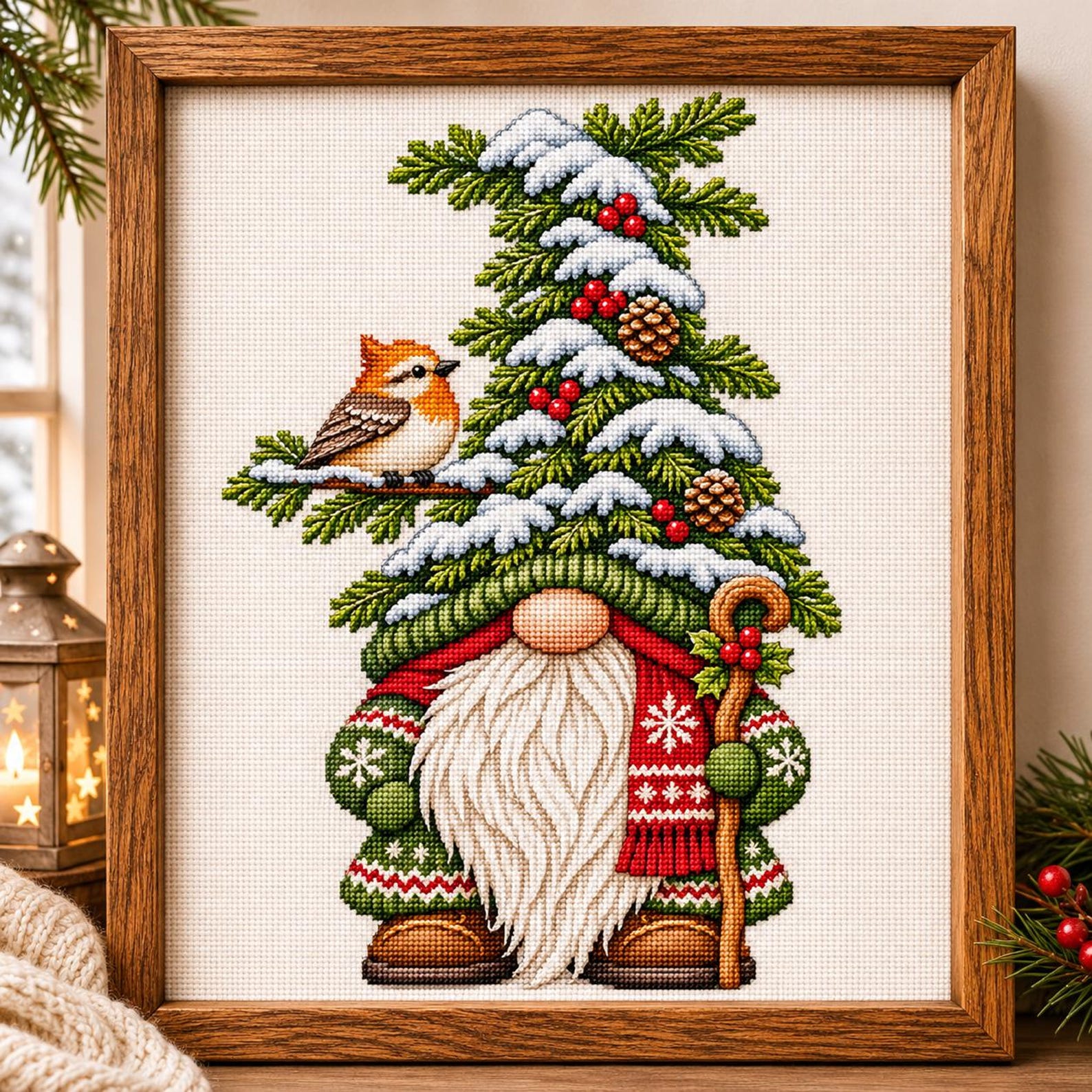
The image immediately above is from the existing snowy gnome product, not the same as our four-season editorial illustration. When browsing patterns, view every listing individually for the exact dimensions, included files, prices and fulfillment method. You can also use our cute seasonal gnome discovery page to explore this topic and reach the shop. For other currently available listings, visit the XStitchPattern Etsy shop.
Finishing ideas for gnome cross stitch gifts
Small embroidery hoop ornaments
Round wooden hoops suit narrow gnomes whose hats stay inside the display circle. For a winter ornament, choose backing materials that will not distort the fabric and secure the hanging loop to the hoop rather than the stitches. Plan the finishing allowance before cutting; the stitched design area alone is not enough to gather fabric at the back.
Seasonal framed artwork
One small frame can host a new theme each season. Matching the same outer dimensions and mat-board openings across several designs makes it easier to rotate them. This is a helpful strategy when you enjoy many gnome styles but do not want permanent seasonal décor covering every surface.
Handmade cards and gifts
For greeting cards, choose a compact motif with enough space around it for an aperture or mounting. A smaller pattern using just one expressive prop is often more legible than a whole gnome-and-garden scene. If you are stitching for several people, calculate a realistic deadline for the stitch work and the time needed to finish each card or ornament.
Patchwork and textile accessories
A stitched gnome can become a decorative pocket, small panel or fabric ornament if you plan seam allowance and backing from the beginning. Test whether the cloth and finished object can tolerate handling or laundering. Do not promise that a delicate, framed-style chart is suitable for frequent washing without checking the thread and finishing materials.
Common mistakes when stitching gnome PDFs
The beard disappears against the fabric
White or cream beard stitches can blend into pale Aida. Before starting, compare the supplied floss and fabric. If your purchased pattern intentionally uses the fabric as part of the beard, that may be a design choice; do not add invented stitches merely to make it more visible. A different fabric background may improve contrast without changing the chart.
The hat looks like one flat block
Some hats depend on two or three close shades to show folds, stripes or knitted texture. Verify that similarly colored threads are sorted correctly, and work in good lighting. If you are making your own original chart, consider simplifying overly dense shading while preserving the fold structure, rather than adding dozens of isolated transitions.
My mini gnome will not fit the frame
Recheck the actual stitch dimensions. A 100-stitch-wide chart on 14-count Aida is roughly 7.14 inches across before border allowance; it cannot fit fully inside a 4-inch hoop simply because the listing calls it “mini.” Higher fabric counts make the stitched area smaller but do not compensate for a design that extends beyond the hoop’s circular opening.
I bought a PDF but expected thread and fabric
Digital pattern-only listings generally contain files, not physical materials. Review the precise product description before buying. If the seller uses a finished hoop as its main image, that photo may show a completed project or mockup rather than the contents of the purchase.
There are too many similar symbols
Try a color-and-symbol view if available, improve your working light and keep a clearly marked progress copy. For long sessions, pause to review counted landmarks. Symbol ambiguity is a reason to ask the designer about accessibility or format options before purchase, not a reason to guess at the thread colors.
Frequently asked questions
Are the cute gnomes shown in the article available as four instant PDF downloads?
No. The spring, summer, autumn and winter gnomes at the top are independent editorial illustrations, not four issued stitch charts. Only a product page with verified chart files can make a legitimate instant-download offer.
Where can I buy an actual gnome cross stitch PDF?
Open a specific authorized designer or shop listing and check its file description. XStitchPattern has individual gnome product pages linked above. The supplied Cutebroidery reference is a separate store, and its gnome collection has its own products and checkout. The associated WooCommerce browsing gateway for this article links to the general XStitchPattern Etsy store, not to that third-party library.
Do gnome patterns always use the same DMC colors?
No. A gnome with autumn pumpkins may have a different floss key from one with a blue winter hat. Use the exact numbers and symbol key supplied with the pattern you actually obtain. Any color counts in the examples here belong only to their named products.
Can beginners stitch a Christmas gnome?
Yes, if the chart has manageable color regions, clear symbols and techniques appropriate to the stitcher’s experience. Not every Christmas gnome is a beginner design. Check its actual size, backstitch and shading before choosing.
How long does a gnome pattern take?
There is no reliable universal number of hours. Actual stitching time depends on stitch count, color changes, your comfort with the pattern, breaks and whether you are learning new techniques. A short digital download time is unrelated to the time needed to complete the needlework.
Can I share a gnome pattern PDF with friends?
Copyright and license terms still apply to digital files. A personal-use pattern may not permit forwarding or reselling the PDF. Share the authorized designer’s listing URL instead of distributing the file itself.
What does Pattern Keeper compatibility mean?
It refers to whether a chart can be used effectively in that type of digital tracking tool. Compatibility varies with the PDF and its structure, and should only be treated as confirmed if the individual seller expressly states or demonstrates it. The editorial illustration in this article has not been converted or tested with such tools.
Choose a gnome you will actually enjoy stitching
The cutest gnome is not necessarily the biggest bundle or the most heavily shaded picture. Choose a theme that fits your recipient, a chart size you can comfortably stitch, a thread key you can follow, and a finish that makes the effort worthwhile. Verify that an instant-download listing contains a real chart, then plan enough fabric for the whole design and its final frame or ornament.
For a winter-specific deep dive, read our woodland gnome stitching guide. For general seasonal chart ideas, continue with the free and premium cross stitch hub. You can also browse the XStitchPattern Etsy store or join our cross stitch newsletter to hear about genuine pattern releases and free offers when available.
Editorial disclosure: this guide independently discusses gnome patterns and references the Cutebroidery homepage and its public collection for factual comparison. XStitchPattern is not affiliated with Cutebroidery and does not sell its PDFs. The four-season artwork is original editorial art; the existing XStitchPattern gnome product photograph and specifications are identified separately. No fictional chart dimensions, DMC numbers or PDF download are attributed to the illustration.