
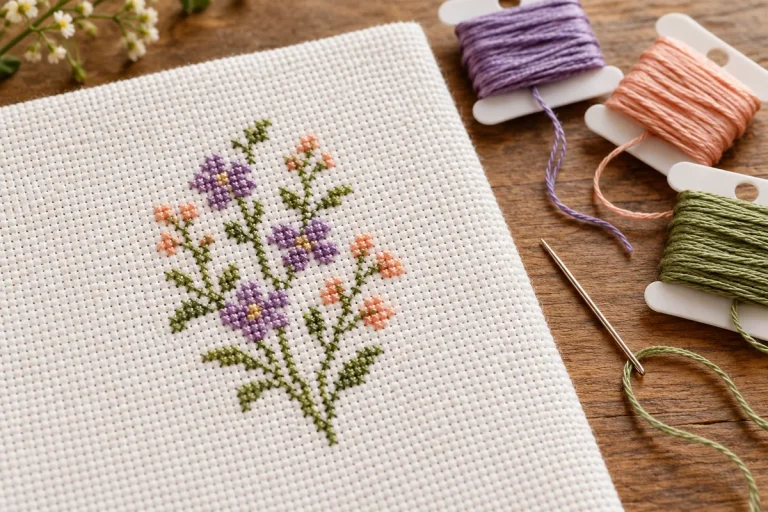
The same floral cross stitch chart can look delicate on cream Aida, bright on white or moody on slate blue. Fabric colour is more than a background: it changes how every petal, leaf and outline reads. This guide gives you a practical way to choose a cloth that supports the design without losing details.

Start with the chart’s lightest and darkest threads
Look at the floss key before selecting fabric. If the flower uses white highlights or pale lemon petals, pure white Aida may make those details disappear. A soft natural or cream cloth can create just enough contrast. If the design has very dark leaves and thin outlines, charcoal fabric may swallow them.
Identify the three most important colour relationships in the artwork: lightest highlight against cloth, darkest outline against cloth, and the midtone that gives the flower body. These relationships matter more than whether the fabric itself is fashionable.
Compare common fabric colours
White Aida gives a bright, crisp base and suits clean graphic flowers with strong coloured outlines. Antique white or cream softens the look and supports cottagecore botanicals. Natural linen-look cloth can make muted leaves feel earthy. Sage or dusty blue creates a themed background but can hide thread colours from the same family.
For a modern floral motif, choose fabric that is lighter or darker than the key outlines, not merely a different hue. Two colours can look distinct as skeins but blend together in small cross stitches when they have similar brightness.

Make a quick fabric-and-floss swatch
Lay the intended embroidery floss across the fabric under daylight, not only beneath yellow indoor bulbs. Separate several strands and fan them out so you can see how the actual stitched colours might sit. Photograph the combination and look at it in grayscale; if the outline merges into the fabric, try a new cloth shade or adjust the outline colour.
On a spare fabric corner, stitch one small leaf, one petal highlight and a dark outline. This test matters especially when you use hand-dyed cloth with mottled areas; parts of the pattern may vanish against darker patches even though the chart looked fine digitally.
Think about the mood and the room
Warm cream, muted terracotta and olive green can feel cosy and botanical. Cool white with vivid pink and teal can give a more playful modern look. Navy cloth paired with pale flowers may suit a dramatic framed piece, but stitching on dark fabric can be slower because the holes are harder to see.
Consider where the work will be displayed. A pale motif in a very bright room may look washed out; a deep cloth background can stand out in a light wooden frame. Fabric colour should support the finished piece, not compete with the flower itself.
Fabric count and finishing still matter
Don’t select colour in isolation from fabric count. The stitch dimensions change with 14, 16 and 18-count Aida, while the ability to see the holes affects how enjoyable the stitching feels. On dark fabric, a small light pad beneath the hoop can help reveal the holes without forcing the needle through fibres.
Leave enough fabric around the motif to frame it neatly. Our fabric count and size guide helps work out dimensions, while the framing article covers a clean display.
Three palette examples to try
Vintage wildflower: oatmeal Aida, dusty pink petals, olive leaves and dark brown details. Fresh spring botanical: white Aida, coral flowers, bright soft greens and a medium grey outline. Moonlit garden: slate or navy Aida, ivory flowers, soft peach centres and pale sage foliage. Treat these as inspiration rather than exact DMC formulas; compare real skeins before purchasing.
Keep the chart’s original palette recorded so you can revisit it later, particularly if you make substitutions. Explore the floral design collection for colour inspiration and verify exact chart contents and availability before ordering.
Frequently asked questions
Is cream Aida better than white for floral designs?
Neither is universally better. Cream often supports very pale petals, while white can make saturated colours look crisp. Test the chart’s lightest shades on each cloth.
Can I stitch a white-flower pattern on dark Aida?
Often yes, but check that the darkest details remain visible and consider that dark cloth can be harder to count.
Sources and next steps
For basic tools and techniques, consult DMC’s cross stitch guide. Find more resources for counted cross stitch on XStitchPattern.
For a related project, explore Wildflower Cross Stitch: Choose a Meadow, Wreath or Bouquet and Wildflower Cross Stitch: A Section-by-Section Stitching Plan.

 English
 French
 Spanish
 German
 Arabic