
A turtle cross stitch pattern can be as simple as a tiny shell-and-flippers silhouette or as absorbing as an underwater scene with coral, sunlight and sea grass. Whether you’re searching for sea turtle cross stitch ideas, a sweet beginner motif or an ocean-themed handmade gift, the most useful starting point is not the prettiest mockup. It’s the shape, stitch count, background coverage and finishing size of the chart you actually plan to follow.
This guide shares 12 original project concepts, practical suggestions for choosing between sea turtles, freshwater turtles and tortoises, illustrated Aida fabric calculations, color-planning advice and simple finishing options. The illustrations are editorial inspiration—not downloadable stitch charts—and any commercial PDF must be purchased from its own designer. If you arrived here after reading the Portuguese feature “Ideias de tartarugas em ponto cruz”, you’ll find a new, independently written approach focused on turning turtle inspiration into a properly measured stitching project.
First choose the right turtle: sea turtle, pond turtle or tortoise
These animals have different outlines, so their shapes affect how a chart reads at small scale. A sea turtle is often shown swimming, with long front flippers and a broad shell. A freshwater turtle might have shorter webbed feet and appear on a pond log, while a tortoise usually has sturdy, non-flipper legs and a higher, dome-like shell. Decorative designs can be stylized, but a recognizable silhouette makes even a four-color project feel intentional.
For a sea turtle, prioritize the head-to-flipper relationship and a clear shell curve. For a pond turtle, a calm side view with a waterline can be more readable than an aerial swimming pose. A tortoise is a good subject for a garden-themed motif with wildflowers or desert plants. Avoid claiming that every cute “turtle” PDF is a biologically accurate sea turtle; check the reference pose if a specific species matters to you.
12 turtle cross stitch ideas, from simple to detailed
Beginner-friendly motifs: clear shapes and fewer decisions
For your first few designs, use open fabric as part of the picture rather than filling an entire square with background stitches. A recognizably simple shell and head are more useful than a complex pattern squeezed into a tiny hoop.
1. Tiny turtle outline for a bookmark
Try a side-profile turtle built from a single consistent dark outline, with a small contrasting shell section. A long, narrow bookmark works especially well when the turtle sits near one end and leaves most of the strip blank. Before stitching, check that the actual motif fits inside the finished bookmark width, including the border and seam allowance. Our mini cross stitch project ideas gives other realistic small-object finishes.
2. Three-tone shell silhouette
A shell can look dimensional using a dark border, a medium green and a pale highlight. Keep the head and flippers relatively simple so the shell remains the focal point. On a small chart, scattered single crosses in nearly identical colors can make the design harder to count without improving the shape.
3. Baby sea turtle and a single wave
A tiny hatchling shape beside one curling wave makes an inviting little card or mini frame. The small head and flippers should be recognizable before you add wave foam. Leave a clear gap between the wave and the turtle’s outline so the shapes don’t merge into an indistinct blue-green patch.
4. A two-color minimalist sea turtle
A dark teal silhouette on warm ivory Aida is a good lesson in negative space. Consider using unstitched fabric for the gaps between the front flippers and the shell. This format suits modern coastal decor and can be a manageable beginner practice piece when the actual chart contains mostly connected full crosses.
Intermediate scenes: introduce movement, coral and color
At the next level, the challenge is the relationship among motifs—not simply a greater number of colors. Keep the turtle clearly visible within the water, reef or botanical background.
5. Sea turtle with coral branches
Position the turtle above or beside a restrained cluster of coral, using warm coral pink or sandy ochre to contrast against teal and sea-green shell colors. Reserve empty cloth around the flippers. For an idea of the visual direction, see our Sea Turtle and Coral design concept; its product page currently describes original cross-stitch-inspired illustration, not a verified chart download with attached files. Check availability before purchasing any PDF.
6. Turtle swimming under a crescent of ocean waves
A curved row of waves can echo the arc of the turtle’s shell and create a feeling of forward motion. Use a few strong aqua and dark-blue blocks instead of dozens of near-identical ripples. A careful count of the open space between wave and flipper will keep the composition clean.
7. Sea turtle and a starfish companion
Pair a larger turtle silhouette with a small, clearly separated starfish. This can be a charming beach-gift motif, provided the starfish does not crowd the turtle’s head. Our Coastal Starfish Sampler concept illustrates a related marine direction; its shop page currently has no attached digital download, so treat it as inspiration and verify file availability separately.
8. Tropical turtle with a botanical border
A few hibiscus-style blossoms or broad tropical leaves can make a sea turtle feel like warm-water wildlife art. Keep the plant shapes in a muted palette so the animal remains readable, and avoid crowding its head with petals. For color-contrast principles that also work around flowers, read our Aida fabric color guide for floral stitching.
Detailed projects: make the shell and water work together
More elaborate chart designs can have subtle shading, several shell plates and isolated underwater accents. Their difficulty depends on actual symbol distribution and specialty stitches, not a generic “advanced” label or arbitrary color threshold.
9. Mosaic shell pattern with separate scutes
A top-view turtle with clearly separated shell plates can look striking even without a full underwater background. Treat the plate borders as a structural map: a missed square in one dark outline can make the shell look uneven. If the pattern includes backstitch for these divisions, add it only where the chart key specifies.
10. Underwater turtle with filtered sunlight
Rays of light fading through blue water create depth, but a full-coverage scene can be a substantial project. Check whether the chart is mostly open background or filled with closely related pale and medium blues. Use realistic time estimates from your own stitching speed rather than assuming that a modest-looking preview is a quick weekend project.
11. Turtle over a detailed reef
A larger reef composition can include coral fans, sea grass and small fish. Decide which elements anchor the picture and which are merely accents. If everything has equal contrast, the turtle may disappear. Organize scattered details into workable sections, using our scattered-stitch management guide for the same counting challenges that appear in detailed corals.
12. Garden tortoise among wildflowers
Not every turtle cross stitch idea needs an ocean background. A walking tortoise among daisies, grasses and little leaves offers a gentle woodland or cottage-garden alternative. Look for sturdy legs and a raised shell in the chart silhouette, then let the flowers frame—not obscure—the face and front feet.
Choose a turtle pattern by the actual PDF, not the styled preview
Before downloading or buying any chart, check the stitch width and height, color legend, stitch types, number of PDF pages, fabric-count recommendation and designer’s use terms. A color-symbol chart can be pleasant for planning while a black-and-white symbol chart may be more readable under dim lighting; a seller offering one does not automatically offer both. “Pattern Keeper compatible” should be considered verified only when the exact PDF has been tested or supported by a clear seller statement.
| Project type | What to look for in the PDF | Likely finishing format |
|---|---|---|
| Small turtle silhouette | Few connected shapes, readable head and flippers | Card, bookmark, mini hoop |
| Turtle plus coral | Motif spacing, coral symbols and a distinct main outline | Small framed scene or hoop |
| Decorative shell mosaic | Clear plate boundaries, contrast between shell shades | Square frame or decorative hoop |
| Full underwater landscape | Background coverage, page overlaps and many related blues | Larger frame or wall art |
For beginners, it’s fine to start with a modest grid, but the source article’s sample size bands are not universal standards. A 35-stitch design filled with complicated single-stitch shading may take longer than a larger silhouette made mostly of connected colors. Evaluate the real chart rather than using stitch dimensions alone to label a pattern easy or difficult.
How large will your turtle cross stitch actually be?
The basic Aida calculation is stitched width in inches = chart width in stitches ÷ fabric count, and likewise for height. Fourteen-count fabric yields larger stitches than 16- or 18-count fabric. The numbers below use a hypothetical 80 × 60-stitch turtle-and-coral chart to demonstrate the formula; they are not specifications of any product on this page. The example fabric cut adds 2.5 inches (6.35 cm) on every side.
| Aida count | Example stitched area (80 × 60) | Example fabric cut with 2.5-in margins |
|---|---|---|
| 14 count | 5.71 × 4.29 in (14.51 × 10.89 cm) | 10.71 × 9.29 in |
| 16 count | 5.00 × 3.75 in (12.70 × 9.53 cm) | 10.00 × 8.75 in |
| 18 count | 4.44 × 3.33 in (11.29 × 8.47 cm) | 9.44 × 8.33 in |
For example, if your purchased PDF is 80 stitches across, 80 ÷ 16 = 5 inches on 16-count Aida. Add an appropriate finishing border: in this example, 2.5 inches on each side gives a 10-inch-wide fabric cut. Always confirm the chart’s actual dimensions and the frame opening. Our cross stitch fabric size guide and Aida count identification tutorial explain the next steps.
A round hoop also needs a shape test: a rectangular chart can extend toward the circular edge even when its width fits the hoop diameter. Trace the stitched rectangle on paper, place it inside a same-size circle and leave a comfortable unstitched gap around the motif before cutting cloth.
Selecting greens, blues and coral colors without losing the turtle
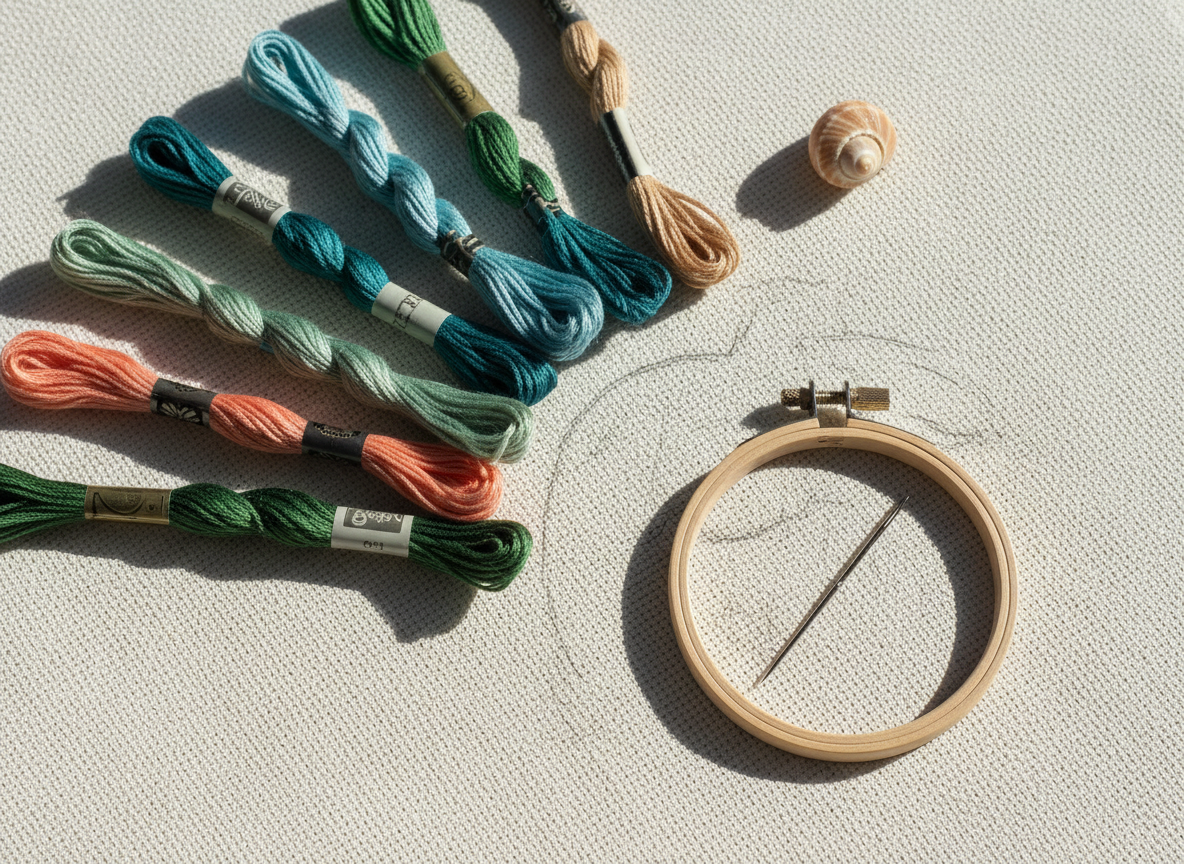
A turtle shell often includes adjacent olive, jade and dark-green tones. Those shades can blend when the background is also green. Separate the turtle using value contrast: place real floss skeins on the proposed fabric, photograph them in natural light, and temporarily view the picture in grayscale. If the turtle disappears, check the chart’s light and dark boundaries.
As a general artistic palette, dark teal can anchor the shell outline, jade or olive can define broad sections, sandy beige can brighten the underside, and muted coral can provide small contrasting reef accents. These are illustrative roles, not guaranteed DMC codes from any particular PDF. Follow a purchased pattern’s actual floss legend rather than substituting colors based on a website thumbnail.
Use actual turtle photos to understand the shape
Real wildlife photographs can help you see where a sea turtle’s shell ends and its front flipper begins. A photographed turtle is not a cross stitch chart, and a single photo is not a reliable source of DMC codes, but it can explain why a tiny change in silhouette matters. In the image below, notice the overall shell outline and the flipper’s direction; then return to the actual symbols of whatever chart you’re stitching.
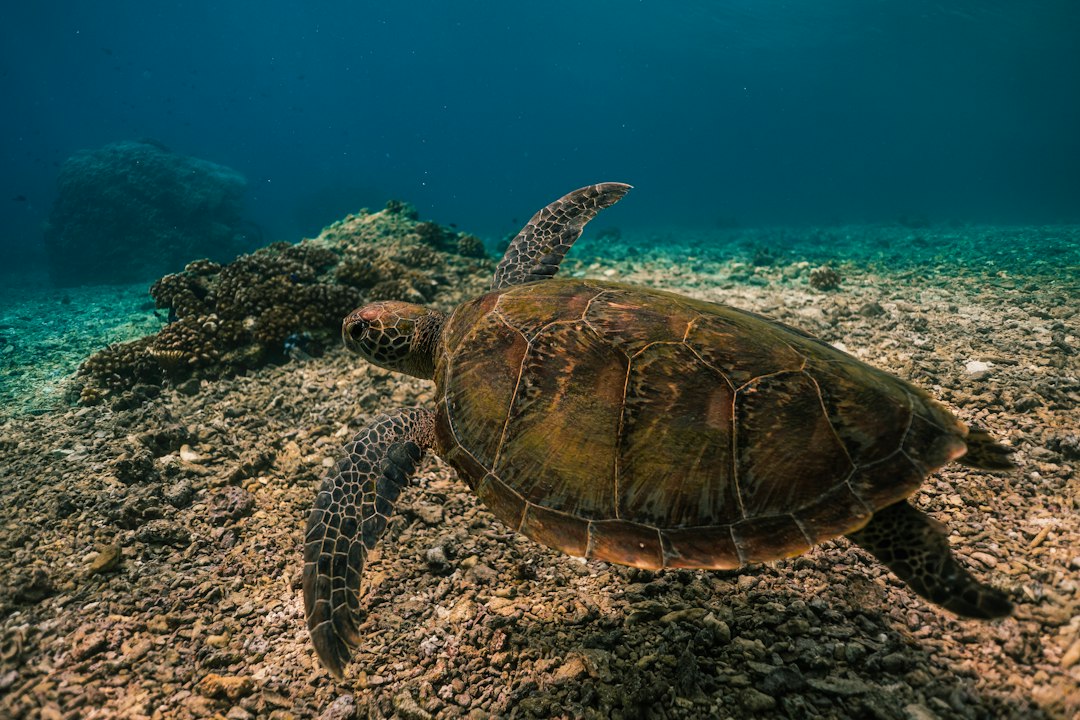
The wildlife photograph above is by Ken Suarez on Unsplash, used for visual reference rather than as a pattern preview.
Stitch a sea turtle in six reliable stages
- 1. Inspect the chart. Read its dimensions, DMC key and special-stitch instructions, then choose a legible printout or compatible digital reader.
- 2. Prepare fabric. Calculate size from the real grid, add margins, protect raw Aida edges and locate a reliable starting reference.
- 3. Map the animal’s silhouette. Establish a portion of the head, shell or a clearly recognizable flipper; double-check its coordinates before stitching distant details.
- 4. Fill connected shell areas. Work consistent full crosses, keeping the top leg of each stitch traveling the same way. Recount at each shell-plate boundary.
- 5. Add the coral and smaller details. Count from known landmarks instead of carrying thread across long blank areas. Apply backstitch only if the chart specifies it.
- 6. Inspect and finish. Check the face, flippers and negative spaces; secure ends, treat the textile as its materials allow and choose a finish with enough fabric to mount neatly.
If the shell includes backstitched divisions, our backstitch tutorial can help with tidy, measured lines. Don’t add arbitrary backstitch to a licensed chart just because a rendered mockup looks especially crisp. A needlework piece should follow the purchased pattern or a design you’ve created yourself.
Turtle embroidery gifts and ocean-themed decorating ideas
A tiny card or bookmark
A small turtle motif can personalize a congratulatory card, gift tag or bookmark for an ocean lover. Use stiff but appropriate backing for paper goods, and leave enough fabric around the design to mount without exposing cut threads. An actual design’s proportions decide whether it can fit a narrow bookmark; don’t crop away important flipper details just to make it fit.
A coastal hoop on a shelf
A turtle swimming above two coral shapes often looks attractive in a plain wood hoop. Keep the fabric comfortably taut and gather the reverse neatly after stitching. For a professional finish, follow our hoop finishing tutorial rather than cutting the Aida flush against the frame rim.
A coordinating marine collection
Pair a turtle-inspired piece with simple starfish, a lighthouse or a sandy-shore palette to create a coherent coastal wall. Our existing Coastal Starfish Sampler illustration and Little Blue Lighthouse concept show other visual directions, but their product pages currently lack verified attached download files. Check availability before buying them as patterns.
A custom gift for someone who loves sea life
A small framed turtle can celebrate a favorite beach vacation, a diving trip or an interest in marine conservation. Personalization may be as simple as a separate dated gift tag or backing label; it does not require altering somebody else’s chart. For keepsake presentation, our cross stitch framing guide covers some of the material and spacing choices.
Want more design directions for your next project? Browse the XStitchPattern Etsy shop for our own digital cross stitch designs and seasonal inspiration. The turtle charts pictured or discussed on other websites aren’t automatically part of our store, and product availability can change.
Turtle cross stitch mistakes worth avoiding
- Mixing up turtle and tortoise outlines: a swimming sea turtle’s flippers have a different silhouette from a land tortoise’s sturdy legs.
- Choosing fabric before reading the actual grid: decorative preview photographs cannot provide reliable cut sizes.
- Making the turtle and sea grass the same tonal value: check contrast so the main animal remains visible.
- Counting a chart rectangle as total stitched crosses: unstitched background squares may make up much of the design.
- Using an illustration-only product as a confirmed digital chart: inspect the file and product delivery details before purchasing.
- Adding uncharted backstitch or hundreds of tiny bubbles: finish the original composition first; extra details can create clutter and may not be permitted by the designer’s license.
Frequently asked questions
Is a turtle cross stitch pattern suitable for beginners?
Yes, some are. A compact turtle with connected colors and a straightforward outline may be an approachable first project. A detailed shell mosaic or full underwater scene can require much more counting. The chart’s symbols, stitch types and background coverage determine difficulty better than the preview image.
What’s the difference between sea turtle and tortoise cross stitch designs?
A sea turtle is typically shown with long swimming flippers and a flatter aquatic silhouette, while a tortoise has stronger land legs and is often depicted in a garden setting. Both can be stylized, but choose the right outline if the animal’s identity matters to you.
How many DMC colors should a turtle chart use?
There is no standard count. A tiny silhouette might use very few shades, while a multi-colored shell with water and coral can use many. Don’t buy floss from someone else’s example palette; use the exact thread key that accompanies your chosen chart.
Can I make a turtle cross stitch on 16- or 18-count Aida?
For ordinary counted full crosses, yes in many cases. The design becomes smaller as the fabric count increases. Check any fractional or specialty stitches and the chart designer’s recommendations first, then recalculate the finished size from the actual stitch width and height.
Where do I find free sea turtle cross stitch PDFs?
Look for designers who explicitly offer a free chart and state their download and personal-use terms. This article offers project ideas and technical advice, not a newly released free sea turtle chart. Never mistake a decorative image, photograph or product illustration for a usable PDF grid.
Does XStitchPattern have a sea turtle product?
The site has a Sea Turtle and Coral concept page that currently displays an original illustration. At the time of review, no downloadable file was attached to that WooCommerce product, so it should not be treated as a verified ready-to-download pattern.
Can I use turtle cross stitch for clothing or baby items?
Turtle embroidery can decorate clothing, pouches or textiles if the fabric, backing and finishing method are suitable for the intended use. For baby-related items, avoid loose threads or detachable decorative pieces and follow the applicable product safety and care requirements. Do not assume an ordinary framed PDF chart is designed for washable apparel.
Choose the turtle story you actually want to stitch
The best turtle project begins with one clear idea: a little silhouette for a bookmark, a coral-framed sea turtle for a cozy hoop, or a detailed shell for patient evening stitching. Pick a chart with readable symbols, size your Aida from the real grid and give the turtle enough contrast against its background. That combination does more for a satisfying result than adding extra colors or an unnecessarily complicated sea scene.
For more practical lessons, explore small counted cross stitch project ideas and the Aida sizing guide. You can also join the XStitchPattern newsletter for free-pattern updates and new tutorial announcements. Our newsletter is separate from the reference article and from any pattern sold by an independent designer.