
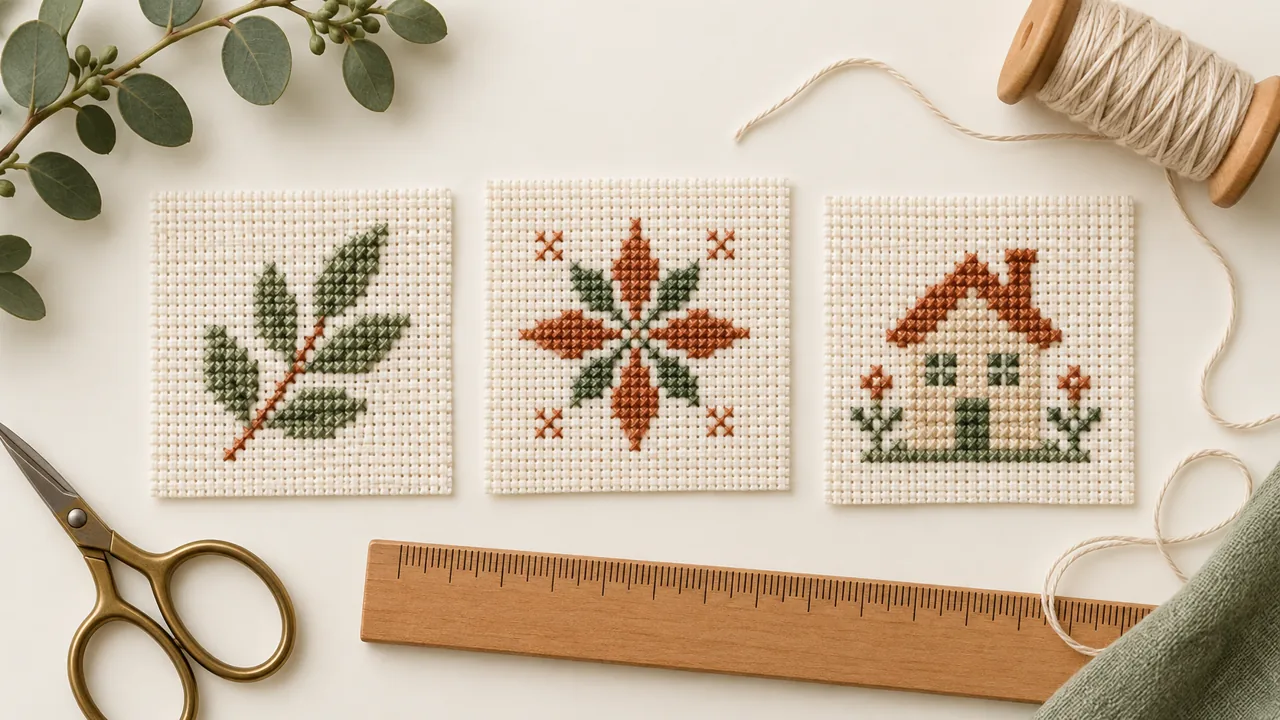
Small cross stitch designs can be satisfying projects for a card, a modest frame or a first stitching session. Their physical dimensions tell only part of the story. A compact portrait with many colors and isolated stitches may demand more concentration than a larger two-color leaf. Compare the chart’s construction as carefully as its finished width.
In this guide
- Small does not always mean simple
- Read four useful specifications
- Compare three fabric counts
- Allow space for the finish
- Choose a manageable first design
- Organize the work without overcomplicating it
- Questions about small designs
Small does not always mean simple
Start with the object you want to make. A card opening sets a hard size limit; a hoop gives you a round viewing area; a bookmark needs a narrow design and a durable finish. This guide helps you choose a chart before stitching. For finishing ideas, see our mini cross stitch projects.
Read four useful specifications
Check the width and height in stitches, the intended fabric count, the number of colors and the stitch types. Then look for full coverage versus open background. A 30 × 30 grid contains 900 possible stitch positions, but an outline flower might use only part of them. A fully filled square uses every position before any outlining is added.
Color count is also incomplete on its own. Four colors in connected blocks are usually easier to organize than four colors scattered one square at a time. Look for a legible key, distinguishable symbols and clear backstitch instructions. A design described as beginner-friendly should not leave you to infer essential stitches from a photograph.
Compare three fabric counts
For a 28 × 42-stitch example worked over one Aida square, the stitched dimensions are 2 × 3 inches on 14-count, 1.75 × 2.63 inches on 16-count, and approximately 1.56 × 2.33 inches on 18-count. The stitch count stays the same. Only the scale changes.
Higher-count fabric may help a motif fit a small opening, but you also need to see and handle the smaller holes comfortably. Choose count for your eyes, hands and desired result. Do not automatically choose the finest fabric because the project is small. Our Aida count comparison can help you decide.
Allow space for the finish
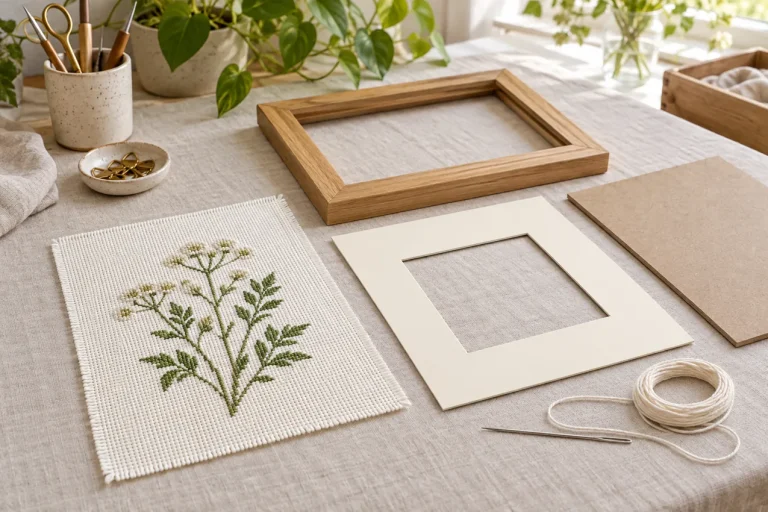
Make a paper template of the stitched area and place it behind the real aperture or inside the hoop. A circular opening can crop the corners of a rectangular design even when its width seems suitable. Include any lettering, border or extended backstitch in the measurement.
For a 2 × 3-inch stitched area with an illustrative 2-inch margin on every side, the starting cloth would be 6 × 7 inches. That is an example, not a universal cutting rule: some mounting methods and hoops need more. Leave final trimming until the finish is planned. Protect the raw edges early using an appropriate Aida edge finish.
Choose a manageable first design
A useful first small chart has a recognizable shape, a small thread palette, mostly connected areas and instructions you can follow without magnification becoming a struggle. Full crosses are a straightforward starting point. Fractional stitches, blended threads and dense outlining can be rewarding later, but they add operations that are easy to miss when judging only the preview.
Before committing to a set of ten gifts, stitch one complete sample and finish it. Record the fabric, strand count and actual effort involved. That sample is more useful for planning than an estimated time printed on a listing. It also shows whether your proposed backing, card or frame works with the thickness of the stitching.
Organize the work without overcomplicating it
Label each floss color with its chart symbol, mark the center and work from a stable reference point. Count from a completed feature and double-check long jumps across blank fabric. Avoid carrying dark thread behind pale unstitched areas. Secure short ends under nearby stitches rather than leaving loose tails where they may show.
Keep a printed or permitted digital working copy and mark progress consistently. Our PDF chart reading guide explains symbols and page overlaps. DMC also provides cross stitch technique resources for beginners.
Questions about small designs
What stitch count qualifies as small? There is no universal standard. Use actual dimensions, coverage and complexity instead of relying on the label.
Can I use leftover thread? Yes, when you have enough and can identify any colors you need to repeat. Test uncertain threads for suitability before washing a finished project.
Where can I start without buying a chart? Our three original beginner charts include counted grids. Use an actual chart rather than copying stitches from a generated illustration.
 English
 French
 Spanish
 German
 Arabic