
If you are searching for how to frame needlework in Cumming, GA, the useful first step is to find a framer who can explain how the textile will be supported. A frame’s color matters, but the mounting materials, tension and space behind the glass determine how comfortably the stitching sits inside it.
In this guide
- Start with the textile, then choose the frame
- Find a local starting point and verify the service
- Prepare a project information sheet
- Ask how the needlework will be mounted
- Specify space between stitches and glazing
- Compare written quotes on the same basis
- Inspect the finished piece before taking it home
- Local framing questions
Start with the textile, then choose the frame
XStitchPattern is a digital pattern website, not a local framing shop in Cumming. This is a planning guide for stitchers arranging their own framing. We have not inspected or used the local businesses mentioned, and a general custom-framing service should not be assumed to have specialist textile-conservation expertise.
Find a local starting point and verify the service
At the time of checking in October 2026, Peachtree Hill Gallery’s own services page lists custom framing and a Cumming, Georgia location. Its general framing description does not, by itself, confirm a particular needlework mounting method. Contact the business directly to ask whether it currently handles your type of textile and can meet your preservation requirements.
Ask to see examples of framed cross stitch or embroidery and request a clear explanation of the support system. Confirm the current location, appointment arrangements and estimated turnaround before traveling. This mention is a research starting point, not a ranking, endorsement or claim that it is the only suitable option.
Prepare a project information sheet
Bring the finished work with its fabric and thread information if known. Note whether it contains silk, hand-dyed colors, beads, metallic threads or anything that may react differently to moisture or pressure. Explain whether it is a contemporary decorative piece or an heirloom you want preserved for the long term.
Measure the stitched area and remaining fabric on every side. Do not cut away the margins before the framer has assessed them. They may be needed for reversible mounting or lacing. If the textile is fragile, stained, torn or has old adhesive residues, discuss a textile conservator before attempting cleaning or removal yourself.
Ask how the needlework will be mounted
Request a method that supports the fabric evenly without pulling the weave out of square. Ask what materials touch the textile and whether the mounting can be reversed later. For valued work, discuss conservation-quality support and avoid treating a sticky board as automatically suitable because it is marketed for crafts.
Le Canadian Conservation Institute’s textile framing guidance is a useful reference for this conversation. Its preservation approach favors stable materials and avoiding direct contact with inappropriate adhesives or acidic supports. A professional should adapt the method to your particular textile rather than promise one solution for every piece.
Specify space between stitches and glazing
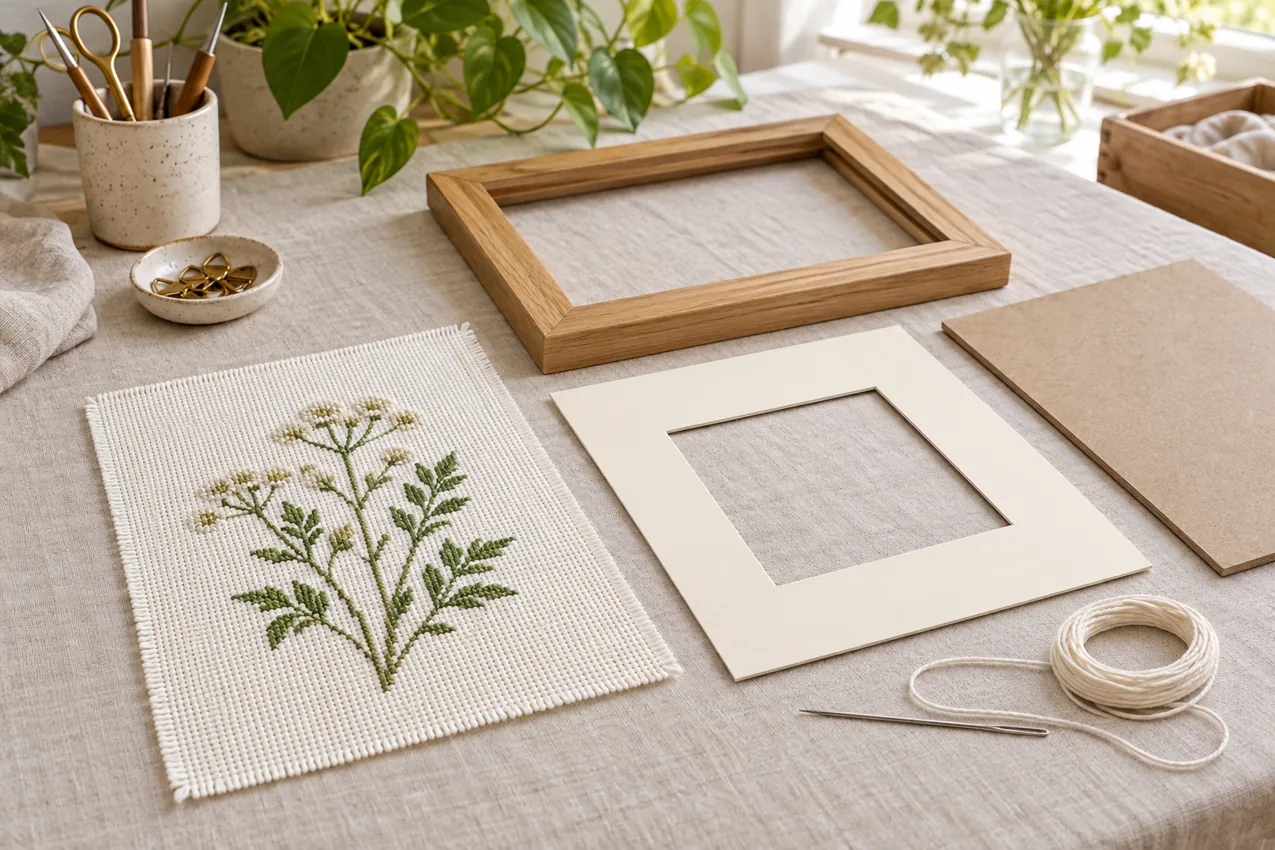
Ask how the glass or acrylic will be kept away from the stitched surface. A mat or suitable spacers can provide room for raised stitches and embellishments. Do not accept a plan that relies on compressing the embroidery to make the frame close.
Discuss the depth of the frame, the appearance of the mat and the backing together. A deep embellished piece may require more space than plain cross stitch. Ask about display conditions as well: keep needlework away from direct sun, damp walls and heat sources. UV-filtering glazing can be useful, but it does not make a textile immune to fading or poor placement.
Compare written quotes on the same basis
A meaningful quote should state the proposed frame, mat or spacers, glazing, support, mounting method and any cleaning or conservation work. Ask which tasks are included and which require a separate specialist. This makes two quotes easier to compare than a single total with no specification.
Before approving the work, confirm the visible opening and whether the design will be fully shown. If a signature, date or small border is near the edge, point it out. Ask whether the remaining fabric will be retained rather than trimmed unnecessarily. Do not assume an apparently cheap or expensive quote tells you how carefully the textile will be handled.
Inspect the finished piece before taking it home
Look at the weave lines: they should appear reasonably straight without visible strain. Check that the design is centered as agreed, that the stitching has clearance behind the glazing and that the back is finished securely. Ask about suitable hanging hardware and how to handle the frame.
For a contemporary project you plan to mount yourself, our cross stitch framing guide provides a separate practical overview. If cleaning is appropriate for your known materials, consult our care guide before framing. Do not wash an unknown or fragile heirloom simply because modern cotton floss can often be washed.
Local framing questions
How much does needlework framing cost in Cumming? We have not verified current prices. Request a written quote based on the actual textile and materials.
Can every picture framer mount embroidery? Ask directly. General framing experience does not establish expertise in reversible textile mounting.
Should I bring the pattern? It can help clarify the intended orientation and border, but the framer must assess the real finished textile and your display requirements.
 English
 French
 Spanish
 German
 Arabic