
Four seasons cross stitch patterns work best when spring, summer, autumn and winter feel like parts of one composition. The challenge is often alignment rather than the individual motifs: a small counting error can shift a whole panel. Before stitching, decide whether the chart is one combined design or a set of independent patterns, then preserve its spacing and overall dimensions from the start.
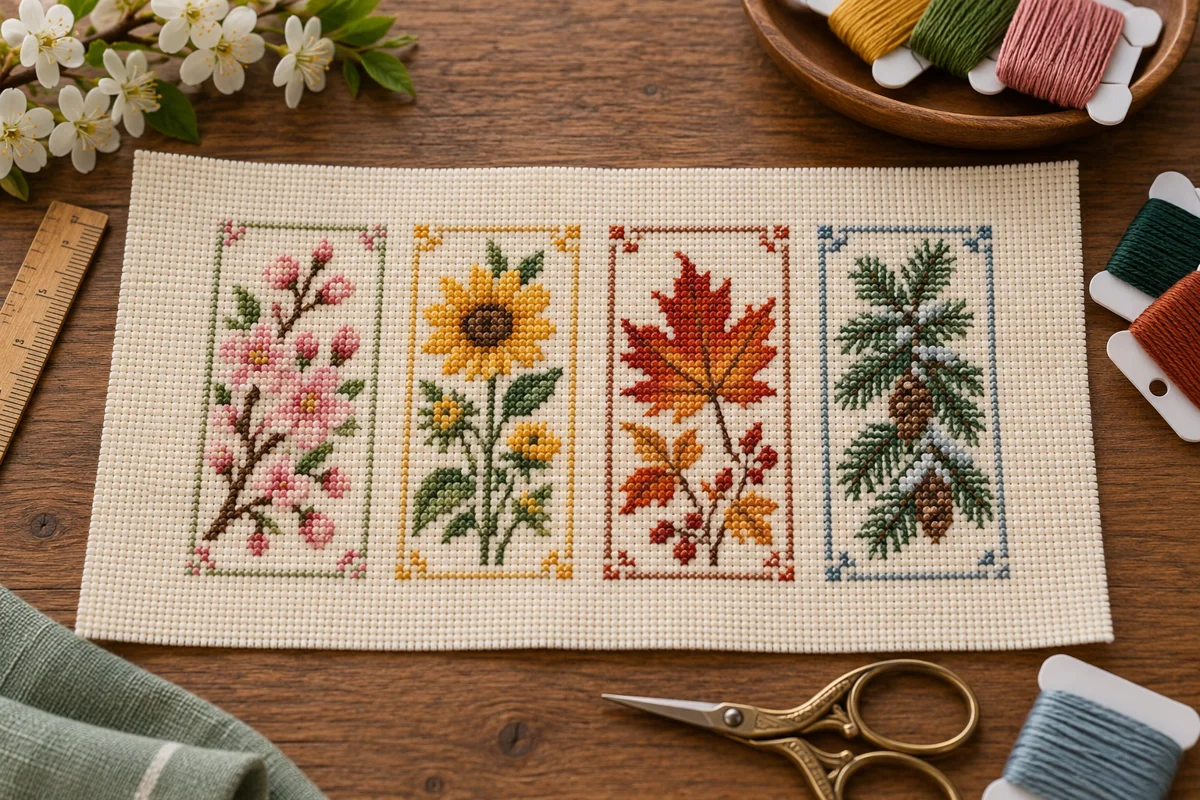
Check whether the four panels form one chart
The current Four Seasons Cats pattern listing describes one complete 300 × 273-stitch composition, with a 26-page PDF and twenty-four colour-symbol chart pages. It presents the seasonal cats together. The word set in a product title should not be taken to mean four separate PDFs or four separately sized pieces of cloth.
Read the file description before planning individual frames. A preview may suggest decorative columns, while the actual chart may share borders or connecting motifs. If you want separate pieces, first confirm the panel boundaries and all the finishing allowances yourself. Do not cut one chart into four fabric pieces on the assumption that the visual gaps are generous mounting borders.
Choose one display plan before calculating the cut
For the complete 300 × 273-stitch layout, the design rectangle measures approximately 21.43 × 19.50 inches on 14-count Aida, 18.75 × 17.06 inches on 16 count, or 16.67 × 15.17 inches on 18 count. These calculations assume one cross per square and describe the chart area, not the required fabric cut.
Choose whether your intended finish is a single frame, a textile hanging or another supported format, then add its allowance on all four sides. A larger count number reduces the physical size but may make counting less comfortable for you. Compare a fabric offcut in your normal stitching light. Our Aida count guide can help you weigh size against visibility.
Establish an overall reference, then locate each panel
Identify the centre and outer bounds of the complete chart. Mark those positions in a removable way compatible with your materials, or record their distances using a reliable counting method. Before starting a new seasonal panel, count from an established reference on both axes. Checking only the horizontal distance leaves the vertical placement unverified.
If you use a grid, distinguish the chart’s numbered coordinates from any page edge or repeated overlap. You can mark only the references you need rather than gridding the entire fabric at once. Scarlet Quince’s gridding tutorial explains different grid approaches. Follow the instructions for your chosen marking material and avoid trapping a removable guide under completed stitches.
Keep seasonal colours organised without losing the shared key
Spring pinks, summer flowers, autumn browns and winter blues may look like four unrelated palettes, but a combined chart can reuse shades across several panels. Store thread by its printed colour number and symbol, with a working note showing where it is used. Keep similar colours separate even when they appear interchangeable on a screen.
The linked cats listing specifies twenty-six colours and two strands for full cross stitches. Treat those as product instructions, then check the supplied key before you begin. Do not change strand count halfway through a shared border simply because another panel is darker. For general handling, DMC explains how to separate stranded cotton; its advice does not replace the individual pattern’s key.
Review the baseline before moving to the next season
Finish a small, recognisable reference area and check it before allowing the next panel to depend on it. A completed flower or border corner can be a useful landmark, but only after its coordinates are correct. Keep your chart progress record local to the original working copy so an unchecked second printout does not send you back over completed stitching.
At each panel transition, check the top alignment, bottom alignment and intervening space. Inspect the full composition from a distance before adding a long border or proceeding to mounting. Preserve the outer cloth until the complete design has been assessed. Our cross stitch framing guide covers the next stage, and the large autumn cat project guide offers a complementary approach to scheduling detailed feline work.
Frequently asked questions
Can I stitch one seasonal panel first?
Yes, if you establish its correct position within the complete layout. Starting with a favourite season does not remove the need to calculate the whole fabric size.
Does the Four Seasons Cats product supply four separate files?
The current listing describes one PDF with all four panels in a combined chart. Check that description before buying supplies for independent pieces.
Must all panels use the same fabric count?
A combined design on one piece of cloth necessarily shares the same fabric count. Separate finishes require a new size and layout assessment.
 English
 French
 Spanish
 German
 Arabic