
Maybe a colour is out of stock, or a bright red doesn’t suit the room where you’ll hang your work. You can substitute shades in a counted cross stitch pattern, but a good swap is about more than matching two thread skeins by eye. Here’s a repeatable method that respects the chart’s light-and-dark structure.

Understand the role of a colour before replacing it
Every thread colour in a design performs a job: background, outline, darkest shadow, middle shade, highlight or an accent. Two greens can look similar on a skein but behave differently once stitched. A pale sage may disappear against cream Aida, while a darker olive can make the entire motif look heavy.
Start by marking where the original colour appears in the chart. If it is a tiny accent, a bolder substitute may work. If the same colour forms a shaded transition across a large flower, you will need to preserve the relationship with its neighbouring colours.
Make a quick inventory of the thread palette
Write down each original DMC number, the approximate number of stitches in that shade, and the colours it touches in the chart. Separate shades into light, medium and dark roles. Then circle the specific shade you want to replace. This little inventory helps you avoid changing a colour that is also used as an outline elsewhere.
If your pattern contains both a colour chart and a symbol chart, check both views. Symbols are the reliable way to identify where a colour is used; colours on phone screens or printers are subject to screen calibration and ink differences. See our guide to reading symbols and floss keys first.

Compare value, not only hue
Hue is the colour family—green, pink, blue. Value is how light or dark a shade is. A successful substitution often matches the original colour’s value even when the hue changes. For example, replacing a medium rose with a medium lavender can work if the design’s dark outline and pale highlights still separate clearly.
Place the original and possible replacement skeins next to the neighbouring palette under daylight. Photograph them and view the photo in grayscale as a simple check of relative brightness. A grayscale preview is not perfect, but it quickly reveals when two neighbouring colours have become so similar that details will merge.
Stitch a small test before committing
On spare fabric, stitch a 5 × 5 square in the old colour next to the proposed replacement. Add a few stitches from neighbouring shades so you can judge the transitions, not only each colour in isolation. Look at the piece under the light where it will be displayed. A replacement that looks dramatic in the skein may be subtle when reduced to tiny stitches.
Where the chart contains several gradual shades, test the whole gradient. If you’re swapping four reds for four blues, choose a four-colour sequence with clear light-to-dark steps; changing only the darkest one often leaves the finished flower looking disconnected.
Keep records so your chart stays usable
Write the replacement DMC number directly on a personal copy of the chart legend, or keep a small substitution table beside your project. If you plan to stitch the design again, save your notes with the PDF. Avoid editing the original designer’s file and redistributing it as your own pattern.
| Original role | What to preserve | What can change |
|---|---|---|
| Outline | Strong contrast | Hue and mood |
| Midtone | Distance from shadow and highlight | Colour family |
| Accent | Visibility at small scale | Personal taste |
Record changes before you pull several strands, so you never need to reverse-engineer a half-finished piece.
Avoid these common substitution mistakes
Do not assume two brands with similar numbers have identical dyes. Never rely on a screenshot for exact colour accuracy. Watch for dye-lot differences when mixing old and new skeins of a shade. Most important, don’t test colours only on white paper if your finished piece is stitched on grey, blue or linen-coloured Aida.
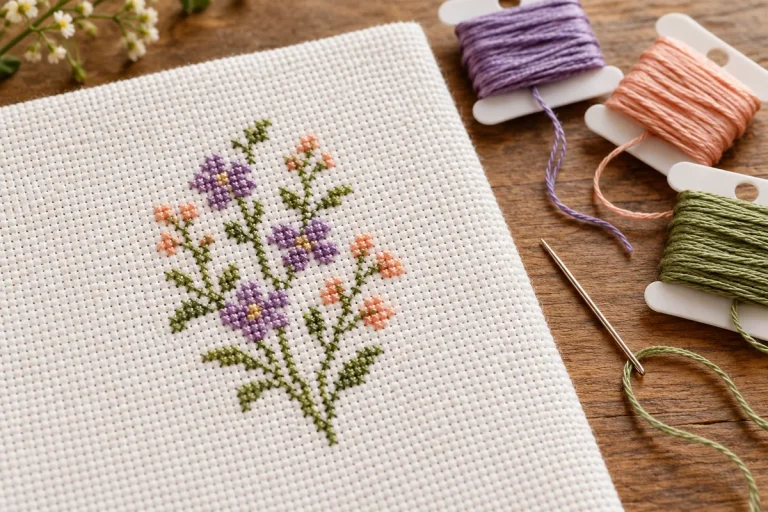
For a small floral design, two or three careful swaps can give an entirely different mood without losing clarity. Our cross stitch design collection is a starting point for planning colour stories; always check product details and download availability first.
Frequently asked questions
Can I replace one DMC number with another directly?
You can, but compare the replacement to adjacent colours, not only to the original skein. A value mismatch can remove important shading.
Will the finished result match the designer’s mockup?
Not necessarily. Substituting threads changes the palette, and screen previews may not show stitched colours accurately. Make a small test swatch.
Sources and next steps
For basic tools and techniques, consult DMC’s cross stitch guide. Find more resources for counted cross stitch on XStitchPattern.

 English
 French
 Spanish
 German
 Arabic