
Discover practical mini cross stitch projects, from bookmarks to ornaments, with stitch-count planning and beginner-friendly finishing tips. This practical guide prioritises clear materials, sensible tests and a finish you can actually use.

What qualifies as a mini cross stitch?
A miniature counted design is small enough to finish without filling a whole cushion or large frame. For a practical starting point, think of charts around 20–60 stitches in each dimension, depending on fabric count and how many colours or isolated stitches they use. A 30 × 30 chart on 14-count Aida produces a stitched area roughly 2.1 inches square, not including any finishing margins.
Small does not automatically mean easy: a tiny realistic portrait with twenty colours may be slower than a larger two-colour motif. Choose a clear silhouette, a limited palette and minimal confetti stitches if your goal is a relaxing evening project.
Five tiny projects with useful finishes
1. Bookmark corner: stitch a narrow repeating flower or geometric border, then finish the edges with felt backing. 2. Greeting-card insert: centre a heart or seasonal sprig behind a card window. 3. Gift tag: stitch an initial and a tiny flower, backed with kraft card or felt. 4. Hanging ornament: use a simple round or square silhouette, and add a ribbon after finishing. 5. Needle-book cover: stitch a small motif and sew it onto felt for a useful sewing accessory.
Choose the finish before choosing a chart. A bookmark may need a design with no wide horizontal elements, while an ornament benefits from enough fabric margin to turn and stitch the edge closed. Finish size matters more than the image shown in an online mockup.

Five mini motifs inspired by nature
6. A single daisy: white petals and a golden centre suit spring cards. 7. A mushroom trio: three tiny mushrooms read clearly with a limited earth-toned palette. 8. An olive branch: a Mediterranean-inspired motif uses slender green leaves and muted purple fruit. 9. A little seashell: a coral-and-cream shell works for a coastal bookmark. 10. A midnight moth: a symmetrical silhouette with one decorative accent offers a striking small project.
For very small motifs, avoid a dozen similar shaded colours. A strong silhouette is easier to read at reduced size, and you can add a single backstitch detail to define eyes, stems or antennae.
Five personal and seasonal mini ideas
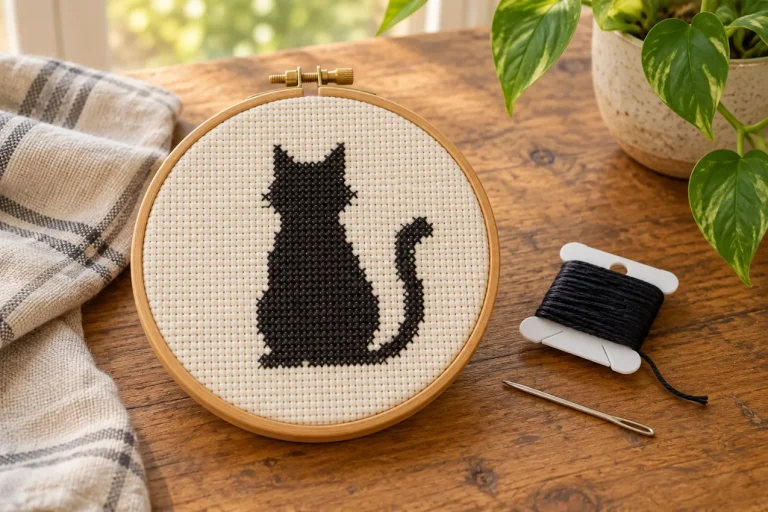
11. A pet paw print: stitch a silhouette in the recipient’s favourite colour. 12. A tiny cat: a sitting-cat outline works well on a notebook sleeve. 13. A holiday star: stitch a small star as a gift-topper insert. 14. A heart with initials: make a personalised anniversary card. 15. A pocket rainbow: four or five muted shades can create a cheerful project for a beginner.
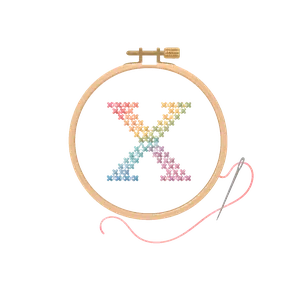
When personalising an initial, remember to leave space around the edges of the stitched block. Test your lettering on graph paper first: even a small font can become too wide when you add an extra character.
Choose fabric count with the finished object in mind
On 14-count Aida, a 42-stitch-wide motif measures about 3 inches. On 18-count Aida, those same 42 stitches measure about 2.3 inches. More stitches per inch means the same pattern finishes smaller. For bookmarks and badges, the difference can decide whether the design physically fits the object.
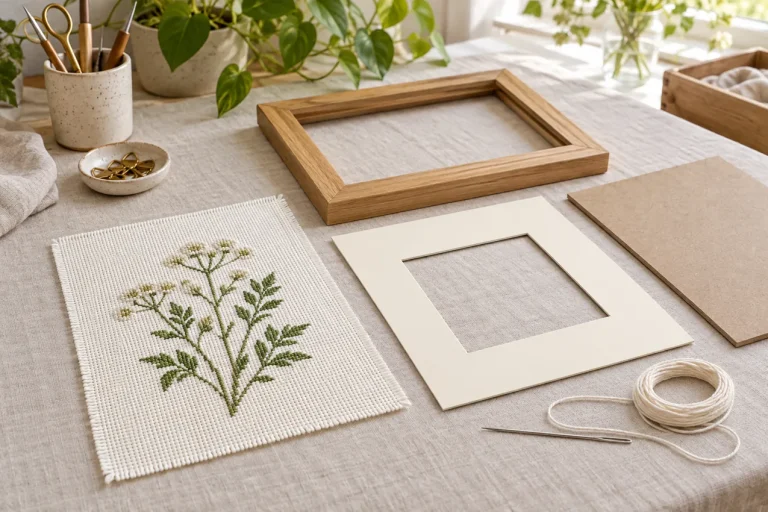
Add finishing allowance separately from the stitched size. For example, a fabric-backed ornament needs extra cloth to fold inward, whereas a card window needs enough fabric to tape behind the mount without the stitching showing through the edge. Check the calculations in our fabric size guide.
How to make mini stitching feel polished
Keep the top diagonals of each stitch consistent and avoid extremely long thread carries across the back of an otherwise sparse motif. If the design has only three colours, prepare a labelled card for each so you do not mix up close shades. Press the finished work carefully from the back using a soft towel to avoid flattening the crosses.
For selling or gifting, label the finish honestly: a chart or mockup is not an actual hand-stitched sample unless someone made it. Browse the XStitchPattern design collection for inspiration, and verify a listing includes the actual stitch chart and colour legend before buying.
Frequently asked questions
How long does a mini cross stitch take?
It depends more on stitch count, colour changes and experience than on the overall fabric size. A few dozen simple crosses can be quick, while a small complex chart may take several sessions.
Are mini designs good for beginners?
Often yes, especially when they use a few solid colours, clear symbols and minimal backstitch.
Sources and further reading
For beginner tools and technique explanations, consult the DMC cross stitch guides. More tools and guides are available on XStitchPattern.
For a related project, explore Mini Cross Stitch Patterns for Cards: Size, Center and Mount and Mini Cross Stitch Patterns on Fabric Scraps: Plan a Matching Set.
Plan a mini before cutting
Choose the finish first, then measure the chart in stitches. For a 28 × 42-stitch design on 14-count Aida, the stitched rectangle is 2 × 3 inches. That measurement excludes the extra cloth needed for handling and mounting. A round hoop may crop the corners of a rectangle, so compare the full shape with a paper template before cutting.
For more precise planning, read about small designs and chart complexity. If the visible opening is very limited, our tiny keyring pattern guide shows how to calculate the available space. You can practise with the free cat chart, which uses one color and full crosses.

 English
 French
 Spanish
 German
 Arabic