
When personalizing cross stitch patterns of cats, preserve the relationship between dark outlines, midtone fur and light highlights before changing individual thread colors. This keeps the muzzle, ears and coat markings readable. A planned substitution can suggest your own pet without turning every shaded area into a flat block.
A palette worksheet for a cat that still looks like a cat
Make a small worksheet with four columns: chart symbol, original thread, visual job and replacement thread. Label the visual job in plain language, such as deep ear shadow, main fur, cheek highlight or nose. Two symbols may both look orange on a screen while doing very different jobs in the design. Replacing them with the same gray can erase the separation.
Choose the darkest and lightest replacements first, then place the middle shades between them. Look at actual cotton beside the fabric in daylight; a monitor preview is only a starting point. A grayscale photograph can help you notice similar lightness, but it does not replace checking real thread or testing how the fabric shows between stitches.
Stitch a compact sample that includes the eye, a patch of fur and the boundary between muzzle and cheek, using the planned fabric count and strand count. Look at it both close up and from the intended viewing distance. If the expression disappears, adjust contrast before extending the change to the whole chart.
Keep a dated copy of the substitution key with the working chart so another stitching session uses the same choices. A new coat pattern, such as turning stripes into irregular tortoiseshell patches, usually needs deliberate changes to symbol placement as well as colors. Our thread substitution guide covers recording changes, while the cat chart selection guide helps when a different base design would be a better fit. Check DMC’s fabric guidance before changing cloth as well as thread.
In this guide
- Change the palette as a coordinated group
- Map each color to its job
- Preserve value before chasing an exact hue
- Keep markings consistent across the chart
- Stitch a representative test patch
- Record changes and finish cautiously
- Common palette questions
Change the palette as a coordinated group
This guide covers modest palette adaptation of a chart you are allowed to use. It cannot make a generic motif into an accurate portrait of an individual cat. For portrait reference selection, see our pet photograph guide.
Map each color to its job
Write down the original chart symbol and thread reference, then label the visual role: deepest shadow, main coat, light fur, stripe, eye or outline. Several thread colors may serve one role across different areas. Keep the nose, inner ears and eyes separate from the main coat group so they are not changed accidentally.
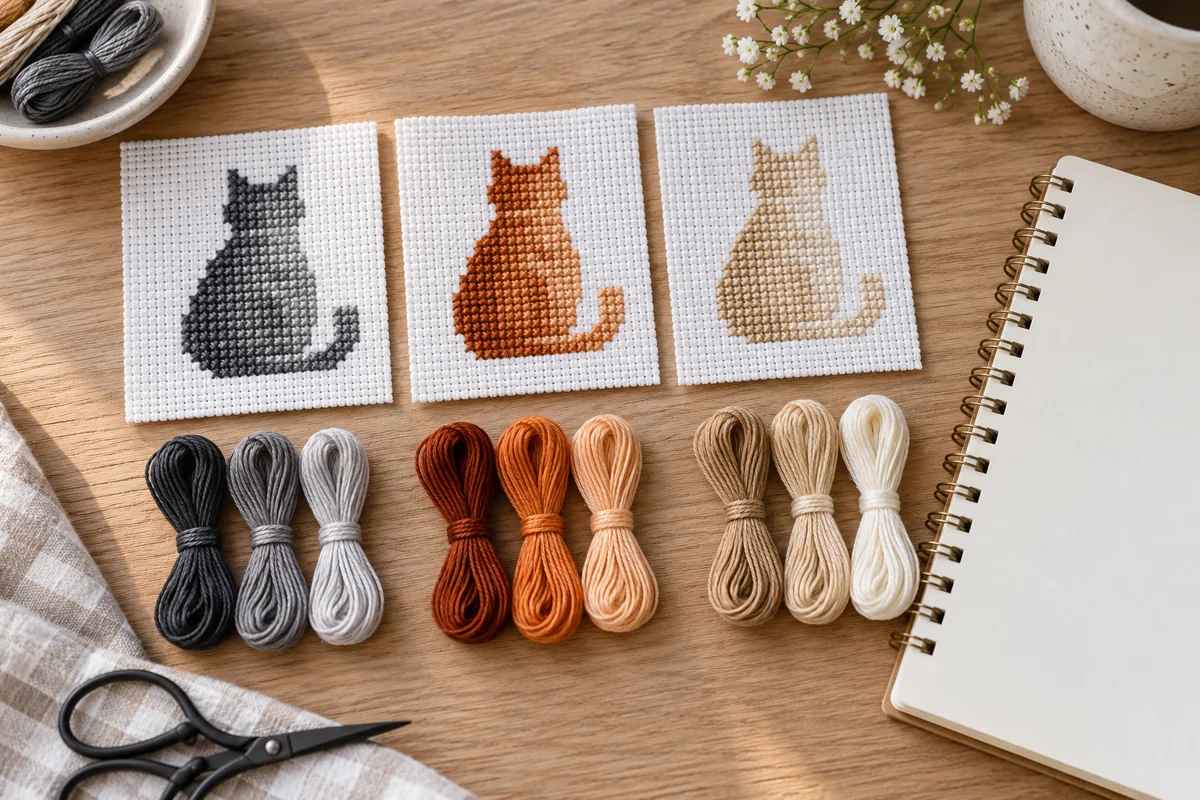
For a simplified three-tone coat, you need a dark, a middle and a light that remain visibly distinct on the chosen cloth. The exact thread numbers depend on the source chart and your actual materials. Do not rely on a screen swatch as a precise match. Dye, display settings and room light all affect how colors appear.
Preserve value before chasing an exact hue
Lay the proposed skeins in shadow-to-highlight order. If two adjacent colors appear nearly identical, the chart’s small stripes may disappear. A phone photograph viewed in grayscale can help you notice weak light-dark separation, although it is only a planning aid and does not replace looking at the thread itself.
Compare the darkest coat color with the outline too. A black outline against an almost-black coat may add little definition, while a very bright outline can change the intended style. Preserve the original contrast relationships unless you deliberately want a flatter graphic result. For a black silhouette, our fabric contrast guide addresses the specific coverage problem.
Keep markings consistent across the chart
Make a substitution table before stitching: symbol, original color, replacement color and role. Use the same replacement wherever that symbol appears unless the designer’s instructions specify otherwise. Random changes by eye can produce a patchwork coat and make it difficult to continue the project later.
Tabby stripes are not simply decoration. They help describe the direction of the body and face. Retain their relative placement, especially beside the eyes and around the muzzle. Large white patches may require changes to the chart’s actual stitch areas; a color swap alone will not reliably create the correct boundaries. Stop and plan those changes on a copy instead of improvising on the fabric.
Stitch a representative test patch
Choose a small area containing a shadow, a midtone, a highlight and, if possible, a stripe. Work it on the same fabric with the same strand count planned for the project. View it at ordinary display distance rather than only close to your eyes. Ask whether the shape remains readable and whether pale fur disappears into the background.
The trial need not reproduce the entire cat. Its purpose is to test the relationships that matter. Keep the sample until the piece is finished and label the thread references. Our floss substitution guide covers broader palette planning, while DMC’s learning resources support the basic stitching techniques.
Record changes and finish cautiously
Keep the original chart key intact and add a separate working key for your substitutions. Mark any colors that are used unchanged. If an unfamiliar or hand-dyed thread is involved, follow its maker’s care instructions and test suitability before washing; do not assume that all substituted threads behave identically.
Before framing, compare the completed work with the planned palette and check for missed highlight stitches. A single missing eye highlight may matter more than a small shade difference in the body. Treat the finished work according to its actual threads and fabric, using our washing and pressing guide where appropriate.
Common palette questions
Can I use a conversion table between thread brands? It is a starting point, not a guarantee of an identical match. Compare the actual colors together.
Will a darker fabric improve a white cat? It can help, but test dark stitches and fine outlines on it too.
Can I turn a tabby into a tortoiseshell by changing colors? Usually the patch boundaries need deliberate chart editing. A simple one-to-one substitution may not give the desired markings.
 English
 French
 Spanish
 German
 Arabic